An AI sales agent is software that uses AI to handle parts of the sales process, such as account research, outreach drafts, lead qualification, follow-ups and CRM updates, with limited human input. Some run on their own. Others draft and wait for a person to approve. The right setup depends on where your team loses time and how much risk a bad message can cause.
- An AI sales agent works toward a goal across several steps. Classic sales automation follows fixed rules you write in advance.
- An outbound AI sales agent earns its keep in research, where the work is repetitive and most inputs are public.
- Start in review mode. Move to autonomy only for segments where the drafts stay good.
- Published results come mostly from vendors and operators. Read them as signals, not guarantees.
- Work out how you sell before you automate it.
What is an AI sales agent?
An AI sales agent is software that takes a sales goal, plans the steps, and acts across your tools to get it done. A glossary from AmpUp lists typical jobs: researching accounts, drafting and sending outreach, updating the CRM, briefing reps and coaching them. Unlike a tool that waits for a command, an agent decides what to do next.
You will see several names for the same idea: AI SDR, digital sales rep, virtual sales agent, AI-powered sales agent. Vendors use them interchangeably, as Crustdata notes. If a page says “AI SDR,” it is usually talking about outbound prospecting.
AI sales agent vs chatbot
A chatbot follows a script. An AI sales agent reads the situation, pulls data from your CRM and past conversations, and chooses an action, according to ChatBot’s guide. That decision step is the dividing line.
AI sales agent vs sales automation
Sequencing platforms run the steps you define. They do exactly what you configured, in the order you configured it. An agent is given an outcome and works out how to reach it, adapting to what it finds. That flexibility is also why agents need review: they can be wrong in ways a fixed rule never could.
AI sales agent vs AI copilot
A copilot helps a person in real time by suggesting or drafting on request. An agent acts more on its own toward a goal. AmpUp points out that the line is blurring, and many products offer both modes in one tool.
What does an AI sales agent actually do?
Most products cover some mix of six jobs. Knowing which one hurts most on your team is the fastest way to narrow the field.
- Account and prospect research. Gathers company context, recent news and likely triggers.
- Lead qualification. Scores leads on fit and intent signals from your CRM and website activity.
- Outreach drafting. Writes a first message grounded in the research.
- Follow-ups and scheduling. Sends reminders, answers replies, books meetings.
- CRM updates and handoffs. Logs activity and passes warm leads to a person with context attached.
- Rep briefing and coaching. Prepares reps before calls and gives feedback afterward.
Mutiny’s guide makes a point worth repeating: matching the agent type to your real bottleneck matters more than which platform you pick inside a category. A team that loses hours to research does not need a better scheduling bot.
Outbound AI sales agent: where research does the heavy lifting
An outbound AI sales agent starts contact with a defined audience instead of waiting for inbound interest. It researches accounts, drafts the first touch, follows up, and routes anyone who responds to a person. The research step is where most of the time goes. Sobot cites HubSpot research putting the share of a rep’s day spent talking with prospects at about one third, with admin and preparation filling the rest.
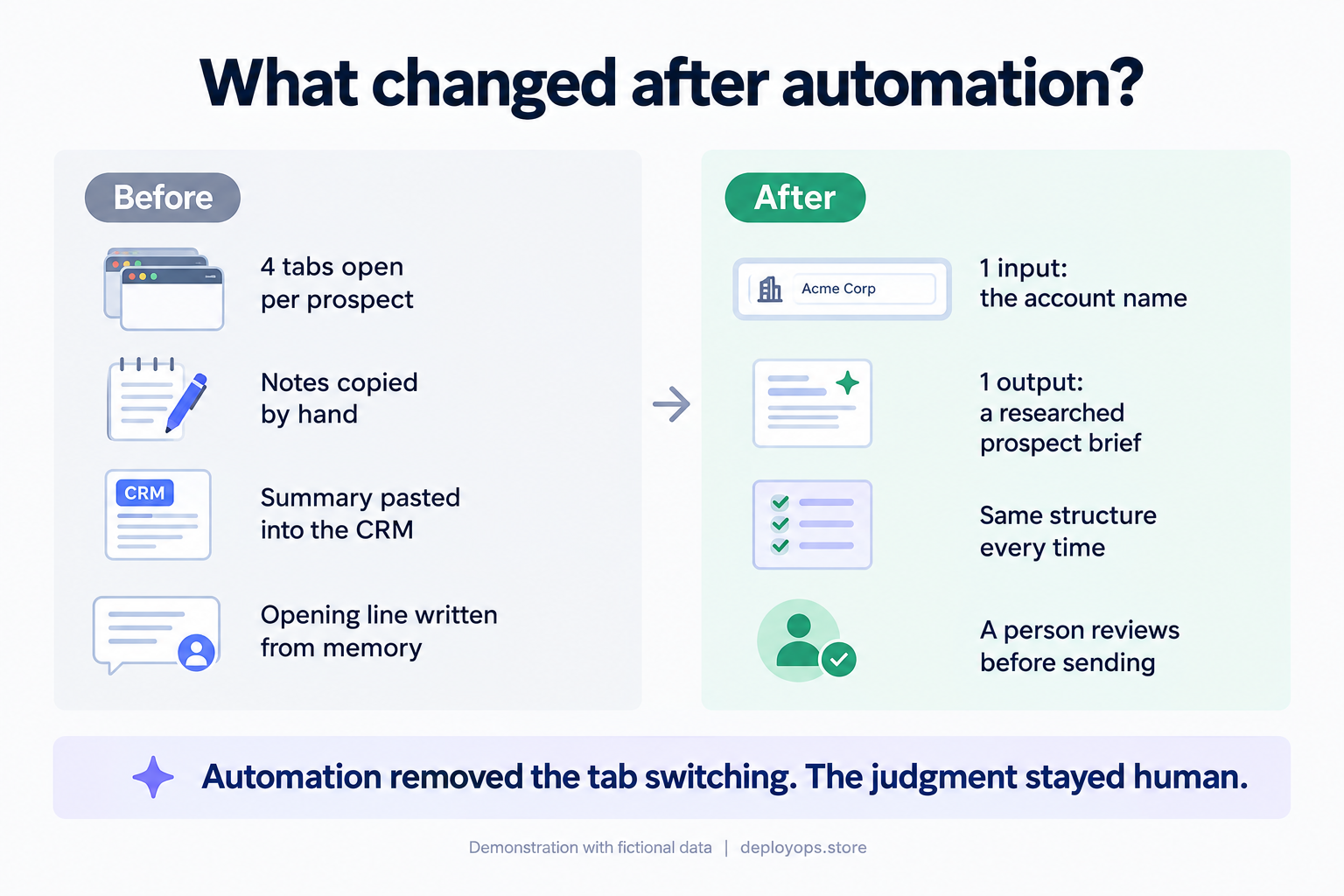
The demonstration below shows the shape of the change for one account. The data is fictional. Edit the opening line and approve the brief to see where the human decision sits.
DemonstrationFictional data, not a customer result
Before: manual research
- Open the LinkedIn profile.
- Open the company website.
- Search for recent news.
- Paste notes into a spreadsheet, then the CRM.
- Write the first line from memory.
Every step lives in a different tab. Quality depends on who did the research and how rushed they were.
After: one researched brief
Input
Account: Northfield Logistics (fictional)
Company context
Regional freight broker with about 120 staff and three depots (fictional).
Likely trigger
Opened a fourth depot this quarter, so dispatch workload is rising (fictional).
Suggested opening angle (editable)
Needs reviewApprove brief
Three things changed in that demo. The research steps stopped being copy and paste. The brief has the same structure every time, so briefs are easy to compare. The decision to reach out stayed with a person. It is a demonstration of a workflow, not a measured result. If you run a pilot, record time per account and edit rate before and after, and publish your own numbers.
How much autonomy should an AI sales agent have?
This is the choice that decides most of your risk. Unify frames it as two models: autonomous AI SDRs that send without review, and agents that draft while reps approve every send. Its summary is a useful rule of thumb:
“AI for SDRs, not AI SDRs.”
Unify, AI for SDRs, Not AI SDRs
Pick a mode below to compare who presses send, what can go wrong, and where each one fits.
InteractiveAutonomy comparison
Draft onlyReview before sendSend automatically
Who sends
The agent drafts and queues messages. A person approves, edits or rejects each one before it sends.
Main risk
The review queue becomes a bottleneck if volume grows faster than reviewer time.
Fits when
Most outbound teams starting out. Track how often reviewers edit drafts to decide when to widen scope.
HubSpot’s Prospecting Agent offers both “Review before sending” and “Send automatically,” as Calilio describes. Its suggested path is sensible: start in review mode, measure how often you edit the drafts, and move to autonomy only for segments where the drafts stay good. Instantly recommends the same pattern for replies, with drafts held in a review queue and people handling security questionnaires and meeting requests, where a fabricated claim creates legal exposure.
AI sales agent case study: what results look like
Real numbers are scarce and mostly self-reported. Outreach’s chief product officer, Nithya Lakshmanan, summed up the mood in a company post:
“AI has gone beyond experimentation. It is actually driving productivity, driving results.”
Nithya Lakshmanan, CPO at Outreach, in Real Examples of AI in Sales
Here is what three published write-ups report, in my own summary of each.
| Source | Setup | Reported result |
| SaaStr | Outbound and inbound AI agents over about six months | A 6.7% outbound response rate, which SaaStr calls double the industry average, and more than $1M closed in 90 days from the inbound agent. SaaStr also says the agents take real daily attention. |
| Snov.io | 3,000 personalized cold emails sent with its own AI agent | About a 30% improvement in conversion, which the company credits to personalization. |
| Outreach customers | AI win-back campaigns and account targeting | SolarWinds saw roughly 45% reply rates on win-back campaigns. ServiceNow reached 330% more prospects inside target accounts. |
How to read these results
All three come from the companies that ran or sell the tools, and none was independently audited. They also measure different things: response rate, conversion and reach. You cannot line them up into one benchmark.
There is a counterweight. Gerry FP, writing in a sales newsletter, argues that replacing SDRs with AI went badly at many companies he spoke with, citing flagged sending domains and damaged reputation. Even in SaaStr’s success story, Knock’s analysis notes the agents needed daily oversight and prompt tuning, and complex selling still relied on human judgment. The consistent pattern across these accounts is that results rise and fall with the human attention behind the agent.
How to choose the best AI sales agent software
There is no single best AI sales agent, because the best one fixes your bottleneck. Use these criteria to compare AI sales agent software on your shortlist.
Criteria that matter
- Data sources and freshness. Relevance AI warns that agents running on stale or incomplete data lead to awkward prospect conversations. Ask where facts come from and how recent they are.
- A real review step. Can a person see, edit and approve every message before it sends?
- Traceable claims. Does the brief show where each fact came from, so a reviewer can check it quickly?
- CRM fit. Does it read from and write to the systems your team already uses?
- Deliverability controls. Sending limits, domain protection and bounce monitoring.
- Clear pricing. You should be able to predict cost at your own volume.
Questions to ask any vendor
- Which part of our process does this replace, and which part stays with a person?
- Can I run it in draft or review mode for the first month?
- What happens when the agent is unsure or lacks data?
- How do you prevent made-up facts in outreach?
- What metrics will we track, and what is the baseline before we start?
- Can I export my data if I leave?
Is your team ready for an AI sales agent?
Tick what is true today. The result tells you whether to pilot now or tidy the process first.
InteractiveReadiness check, 5 questions
- We can describe our ideal customer in a few clear sentences.
- Our CRM or lead data is current enough to trust.
- We know which prospecting steps are manual today.
- A named person will review the agent’s output every week.
- A person approves outreach before it sends, or we will start that way.
0 of 5 ticked
Map your process first. Write down your ideal customer and the manual steps in prospecting before you pick a tool. An agent will repeat whatever process you give it.
How much time could an AI sales agent save?
Use your own numbers. The defaults are examples, not benchmarks. Review time is included, because reviewing is not free.
InteractiveWeekly time estimate, example values
Accounts per week
Manual research (min per account)
Reviewing a brief (min per account)
12.7
hours saved per week
54.8
hours saved per month (4.33 weeks)
Manual research: 16.7 hours per week. With agent briefs and review: 4 hours per week.
Common mistakes when adopting an AI sales agent
- Buying before mapping the process. The Mooon AI team puts it plainly:
“Figure out how you sell first, then automate.” - Mooon AI Team, What Is an AI Sales Agent
- Feeding it stale data. A confident message built on an old fact is worse than no message.
- Going fully autonomous on day one. Bad targeting at volume can get sending domains flagged.
- Measuring nothing. Without a baseline you cannot tell whether the agent helped or only felt busy.
- Skipping the owner. Someone must tune prompts, check drafts and watch the numbers every week.
AI sales agent FAQ
What is an AI sales agent?
An AI sales agent is software that uses AI to handle parts of the sales process, such as account research, outreach drafts, lead qualification, follow-ups and CRM updates, with limited human input.
Is an AI sales agent the same as an AI SDR?
Mostly yes. The terms AI sales agent, AI SDR and virtual sales rep are used interchangeably by most vendors. AI SDR usually points at outbound prospecting work.
What is the best AI sales agent?
The best AI sales agent is the one that fixes your actual bottleneck, whether that is research, qualification, outreach or follow-up, and keeps a human review step where mistakes are costly.
What is an outbound AI sales agent?
An outbound AI sales agent starts contact with a defined audience. It researches accounts, drafts first touches, follows up, and routes interested prospects to a person.
Will an AI sales agent replace my sales team?
The sources reviewed here say no. Agents work well on research, drafting and triage under human review, while complex selling still depends on human judgment.
How do I measure whether an AI sales agent works?
Record a baseline first. Then track time per account, how often people edit the agent’s drafts, reply rate, meetings booked, and bounce or spam complaints.
Is there an AI sales agent case study with real numbers?
Yes. SaaStr, Snov.io and Outreach have published results. They are reported by the companies involved and are not independently audited, so treat them as signals.
What is AI sales agent software used for in lead generation?
For lead generation it researches target accounts, builds and scores lists, qualifies leads against fit and intent signals, and drafts the first message for a person to approve.