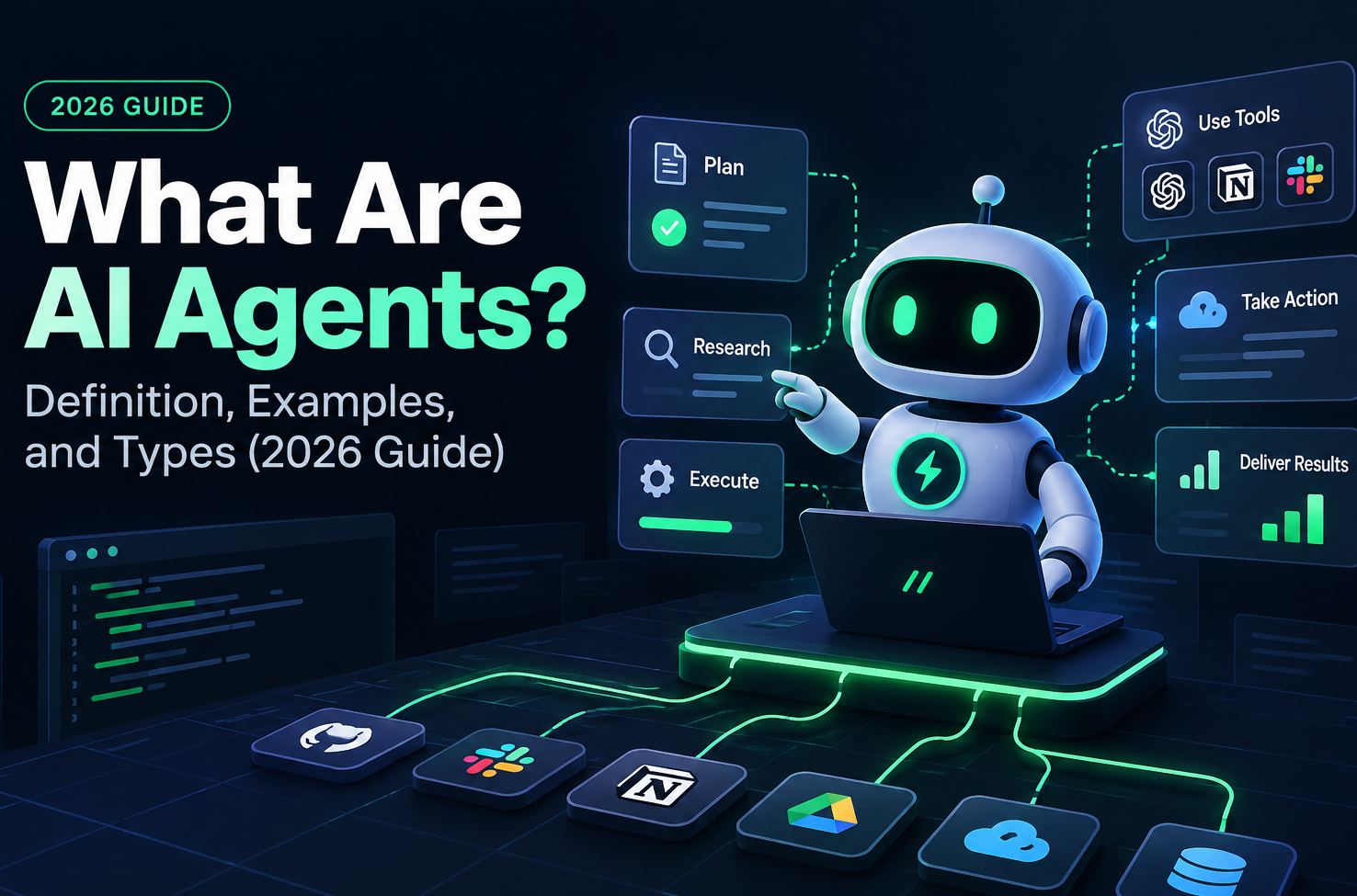
An AI agent is a software system that observes information and selects actions toward a task or goal. Modern language-model agents often use tools, such as search or business APIs, but agent concepts are broader than chat applications.
AI agent definition for beginners
Think of an agent as a system with inputs, a decision mechanism and permitted actions. In a support workflow, it might read a request, look up an order and prepare an answer for review.
AI agent vs chatbot
A chatbot is an interaction format. An agent describes a system’s ability to act toward a task. A chat product can include an agent, and an agent can run without a chat screen.
Types of AI agents
Simple reflex agents
Choose an action from a current observation using a rule, such as routing a form with a specified category.
Model-based reflex agents
Maintain an internal representation of relevant state, allowing decisions to use more than the latest input.
Goal based AI agents
Choose actions in relation to a desired outcome under defined operational constraints.
Utility-based agents
Compare possible outcomes using a defined preference or scoring function.
Learning agents
Use an implemented learning mechanism to change behavior from verified operational experience.
Multi agent systems
Several agents coordinate or divide work across specific role boundaries.
Frequently Asked Questions
What is an AI agent in simple words?
An AI agent is software that uses information to choose actions toward a task or goal. A business agent might read a request, retrieve a record and prepare the next step. Its allowed actions should be limited, and important results should be checked before they affect customers or systems.
Are all AI agents based on large language models?
No. The agent concept includes systems that use rules, internal state, planning or other decision methods. Language models are one approach, particularly useful for interpreting and generating text. The appropriate design depends on the task, available inputs and required reliability, rather than whether it uses a conversational model.
What is the difference between goal-based and learning agents?
Goal-based describes how an agent selects actions in relation to an objective. Learning describes a mechanism for changing behavior from experience. These properties can overlap in one system. A goal-driven workflow does not automatically learn, and a system that stores history does not necessarily update its underlying model.
Do multiple agents always work better than one?
No. Multiple agents can help divide distinct tasks, but coordination adds latency, cost and new failure modes. Start with the simplest design that meets the requirements. Compare completed-task quality and operating effort before assuming that a larger number of agents makes a workflow more capable or reliable.