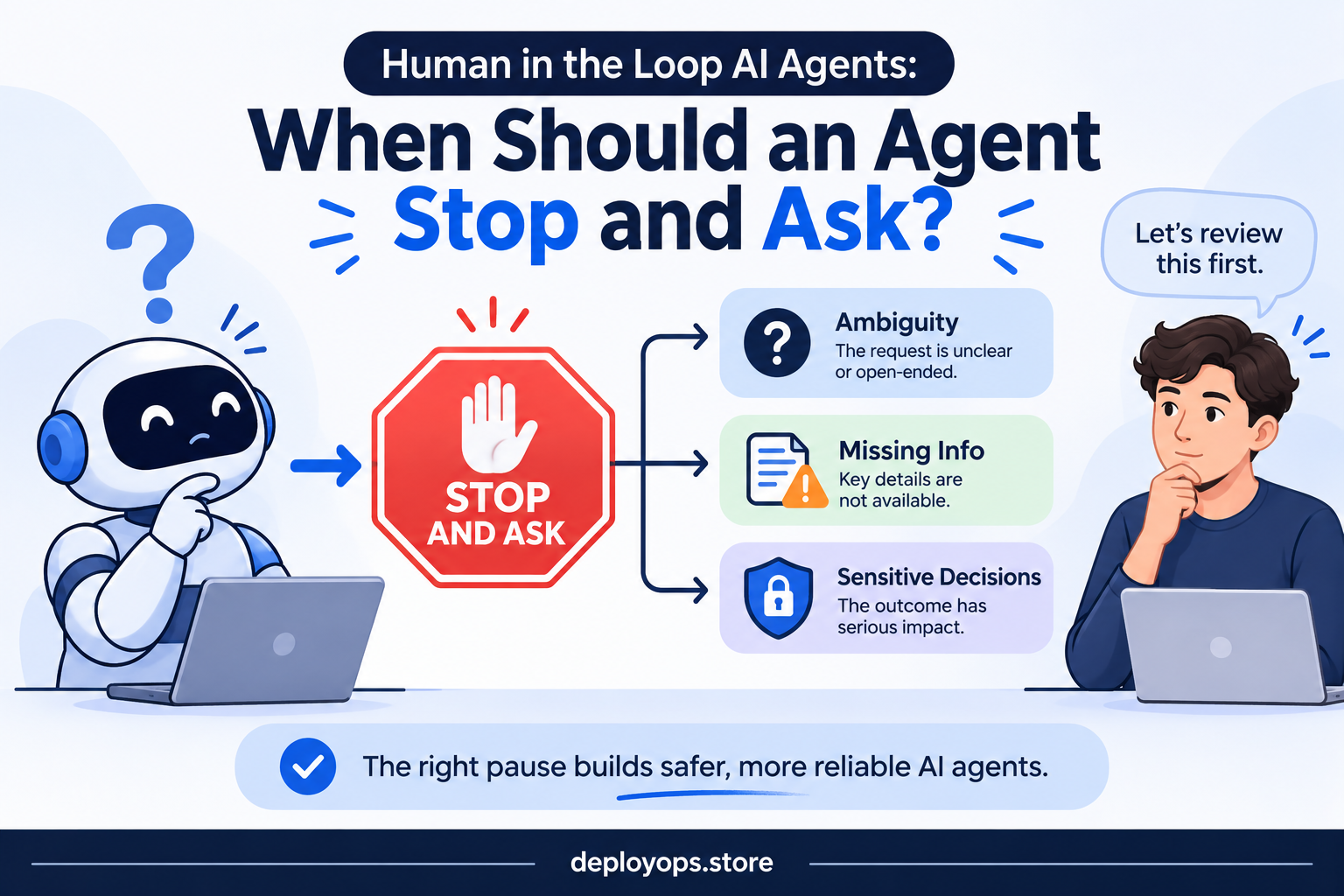
Quick answer: An AI agent should stop and ask a person when an action is hard to undo, when the request can be read two ways, when it is missing information it needs, or when the outcome affects customers, money or legal standing. For everything else it should act, keep a log and move on. That is the core of human in the loop AI agents: a few well-placed checkpoints, not constant supervision.
An agent that never asks questions is not confident. It is unsupervised. An agent that asks about everything is just a slow way to do the work yourself. The useful middle is a small set of checkpoints, placed where a wrong guess costs more than a ten-second question.
This guide covers when an agent should stop and ask, with concrete examples for ambiguity, missing information and sensitive decisions. It also gives you two tools to practice with, an ask-or-act calculator and a short quiz, plus rules you can paste into your own agent instructions. Every claim is sourced, and figures carry their dates so you can check them.
What is agentic AI, and where does a human fit?
Agentic AI describes software that pursues a goal across several steps, choosing and using tools along the way, instead of answering one prompt and stopping. OpenAI’s practical guide to building agents defines it plainly: “Agents are systems that independently accomplish tasks on your behalf.” Looking up a record, drafting an email, filing a ticket and updating a CRM field, in sequence and with nobody clicking between steps, is a typical example.
Anthropic’s engineering team separates workflows, where code decides the path, from agents, where the model decides the path as it goes. Their description of how an agent runs includes a line that frames this whole article:
…potentially returning to the human for further information or judgement.
The question is not whether an agent can come back to a person. It is when it should. Anthropic describes agents pausing for feedback at checkpoints or when blocked. OpenAI recommends planning for human intervention when an agent passes a failure limit or faces a high-risk action. Both point to the same design: people stand at specific gates, not at every step.
Agentic AI vs generative AI: why the question changes
Generative AI produces content when asked. Agentic AI takes actions on your behalf. That difference changes what a mistake looks like. A weak paragraph from a generative tool costs you a rewrite. A wrong action from an agent can send an email, change a record or spend money before anyone notices.
| Generative AI | Agentic AI | |
|---|---|---|
| What it does | Produces text, images or code in response to a prompt | Plans steps, uses tools and takes actions toward a goal |
| Typical mistake | A wrong or weak answer | A wrong action |
| Who sees it first | The person reading the output | Often a customer, a database or a bank account |
| Cost of being wrong | A rewrite | Cleanup, refunds, lost trust |
| Where a human checks | After the output, by reading it | Before irreversible actions, at defined checkpoints |
This is why agentic AI vs generative AI is more than a vocabulary debate for anyone deploying agents. Reading is a built-in checkpoint for a generative tool, because a person sees the output before anything happens. An agent acts first. Its checkpoints have to be designed in.
Human in the loop, on the loop and over the loop
Human in the loop is often used as a catch-all, but it covers several distinct modes. Tap through them to see where each one fits.
Human in the loop
A person approves or edits each consequential action before it runs. The agent proposes and the human commits.
- Best for
- Irreversible, regulated or customer-facing actions
- Example
- An agent drafts a $2,400 refund and a manager approves it
- Watch for
- Slow throughput, and reviewers who approve without reading
Most real systems mix modes by action. One agent might clean its scratch files alone, let a lead sample its replies daily, work within a refund limit set by policy, and need approval for anything above the limit. Databricks makes the same point in its guide, advising that human review be “risk-based, not everywhere.”
Why more oversight is not always safer
Putting a person in front of every output can backfire. Reviewers who approve hundreds of items an hour stop reading them. Melanie Fink of Leiden University’s Europa Institute, writing on human oversight under the EU AI Act, makes the case for design that avoids relying on people alone.
…avoids overreliance on human oversight as a standalone safeguard.
Article 14 of the EU AI Act names the same risk. It expects oversight measures that keep the reviewer aware of the tendency to over-rely on automated output, a pattern known as automation bias. Article 14 applies to high-risk AI systems, not to every agent, and the application dates for those obligations have been shifting, so check the current timeline if it affects you.
When should an AI agent stop and ask? Four triggers
Across vendor guidance and practitioner write-ups, four triggers keep recurring. Use them as your default checklist for any agent that can take real actions.
1. Ambiguity
Take the instruction “Clean up the customer list.” It could mean removing duplicates, deleting inactive accounts, fixing formatting, or all three. If the agent guesses wrong and the action is hard to undo, a ten-second question is far cheaper than a two-hour recovery. The test is simple: could a reasonable person read this request two ways that lead to different actions? If yes, and the actions differ in cost, ask.
2. Missing information
“Send the proposal to the client.” Which version? Which contact? Which pricing sheet? An agent that fills the gaps with assumptions looks confident right up to the moment it attaches the wrong file. Missing information differs from ambiguity. The request is clear, but the agent lacks an input it needs. The right move is a specific question (“Which of these two proposals?”) and never a vague one (“Can you clarify?”).
3. Sensitive or irreversible decisions
Deleting data, spending money, changing permissions, messaging a customer in your name and publishing anything public all belong here. OpenAI’s guide names high-risk actions such as large refunds as a reason to involve a person. The question to put to every action is whether you can take it back. If you cannot, the agent proposes and a person commits.
4. Repeated failure
OpenAI also recommends failure thresholds. If the agent cannot work out what a user wants, or cannot complete a step after several tries, it should stop and escalate instead of looping. Endless retries burn budget, trip rate limits and can lock accounts. Set a retry limit and make reaching it a handoff, never a silent failure.
A common fifth signal: low confidence
Some support platforms add confidence scores. Twig describes one setup that answers on its own above 0.8, offers a tentative answer with a human option between 0.5 and 0.8, and escalates below 0.5. Treat numbers like these as starting points to tune against your own results, because a model can be confidently wrong.
Autonomous AI agents: earn autonomy one action at a time
Autonomy is not a switch. The agent governance vendor Prefactor frames it as “something you earn per action, not a global setting.” That is a practical stance for any autonomous AI agent. Start with a person approving the consequential steps, measure how often the agent is right on those steps, and remove the checkpoint only where the numbers support it.
What to measure
- Approval rate by action type. Which actions do people approve almost every time?
- Edit rate. How often does a person change the proposal before approving?
- Rollback or override rate. How often does an approved or automatic action get reversed later?
- Time to approve. Long delays show where the checkpoint slows real work.
- Escalation rate. A rising rate means the agent’s scope has outgrown its instructions.
A 100 percent approval rate can mean the agent is excellent, or that nobody is looking. Sample approved items from time to time and read them.
The market context
Gartner’s June 2025 forecast says more than 40 percent of agentic AI projects will be canceled by the end of 2027, citing escalating costs, unclear business value or inadequate risk controls. Gartner senior director analyst Anushree Verma said current projects are early experiments:
…mostly driven by hype and are often misapplied.
The same forecast expects at least 15 percent of day-to-day work decisions to be made autonomously by 2028, up from 0 percent in 2024. Autonomy is growing, and inadequate risk controls are one of the three reasons Gartner gives for cancellations. That makes checkpoints a business concern as well as a safety one.
AI automation tools: what to check before you hand over the keys
Many AI automation tools now advertise agent features. Gartner warns of “agent washing,” where vendors relabel chatbots and assistants as agentic, and estimates that only about 130 of the thousands of agentic AI vendors offer genuine agentic capability. Before you trust any tool with real actions, check that it supports a proper handoff. Tick what applies to the tool you are evaluating.
Handoff readiness checklist
Seven questions to ask any vendor or build team.
0 of 7. Keep a person approving every consequential action until more of these are in place.
Design the handoff, not only the trigger
Knowing when to ask solves half the problem. The other half is how. Permit.io, which builds authorization tooling, describes the principle in one line: “You may ask, but a human decides.” A good ask makes the person’s job a ten-second decision. It contains five parts:
- What the agent was asked to do.
- What it is about to do.
- Why it paused.
- Its recommendation, with one alternative.
- What happens if nobody replies, and how to undo the action.
Here is how that looks for the proposal example from earlier:
Paused before sending. Task: send the proposal to Acme. I found two files: Proposal v3 (June pricing) and Proposal v4 (new pricing, no approval on record). Recommendation: send v3. Reply “v3”, “v4” or “hold”. If I hear nothing by 5 pm, I will hold the email and take no action.
Plan for silence too. A pause with no timeout path is a stuck workflow, and a stuck workflow trains people to approve everything just to clear the queue.
Five mistakes that make human in the loop fail
Asking too much
If every action needs approval, people approve in bulk to clear the queue. The checkpoint becomes decoration. Keep approvals for actions that deserve them.
Asking too late
A question that arrives after the email has gone is a notification, not a checkpoint. Place the pause before the action.
Asking vaguely
“Is this okay?” forces the person to rebuild the context. Show the proposed action, the reason and a recommendation.
Treating approval as proof of quality
High approval rates are good news only if reviewers are reading. Sample approved items and check them against the outcome.
Forgetting the silent case
Decide in advance what the agent does when nobody answers. Holding and taking no action is the safe default for anything irreversible.
Frequently asked questions
What does human in the loop mean for AI agents?
It means building specific points into an agent’s workflow where it stops and waits for a person to approve, correct or decide before continuing, instead of running end to end alone. The checkpoints sit at high-risk, ambiguous or low-confidence moments.
When should an AI agent ask for human approval?
When the action is hard to undo, the request has more than one reasonable reading, required information is missing, the outcome affects customers, money or legal standing, or the agent has failed the same step several times.
What is the difference between human in the loop and human on the loop?
In the loop means a person approves actions before they run. On the loop means the agent acts and a person monitors and can step in. Over the loop means people set the policies, limits and permissions the agent works within.
Are autonomous AI agents safe to run without a human?
Only for low-stakes tasks that are easy to undo. For anything that touches customers, money or data you cannot restore, keep a checkpoint. Gartner expects more than 40 percent of agentic AI projects to be canceled by the end of 2027, and lists inadequate risk controls among the reasons.
Does the EU AI Act require human oversight of AI agents?
Article 14 requires human oversight for high-risk AI systems and expects that oversight to be meaningful. It does not apply to every agent. Whether yours counts as high-risk depends on its use, and application dates have been shifting, so check the current timeline or ask legal counsel. This is general information, not legal advice.
How do I stop an AI agent from asking too often?
Tie every question to a trigger: ambiguity, missing information, an irreversible action or repeated failure. Track how often people approve without changes, then move those action types to act and report. Review monthly, and set autonomy per action instead of globally.
Key takeaways
- Ask when an action is hard to undo, ambiguous, missing information or sensitive. Otherwise act and log.
- Agentic AI acts before anyone reads it, so checkpoints must be designed in. That is the practical gap between agentic AI and generative AI.
- Mix oversight modes by action: in the loop for high stakes, on the loop for volume, over the loop for policy.
- Earn autonomy per action using approval, edit and rollback data.
- A good handoff states the task, the planned action, the reason, a recommendation and the no-reply default.