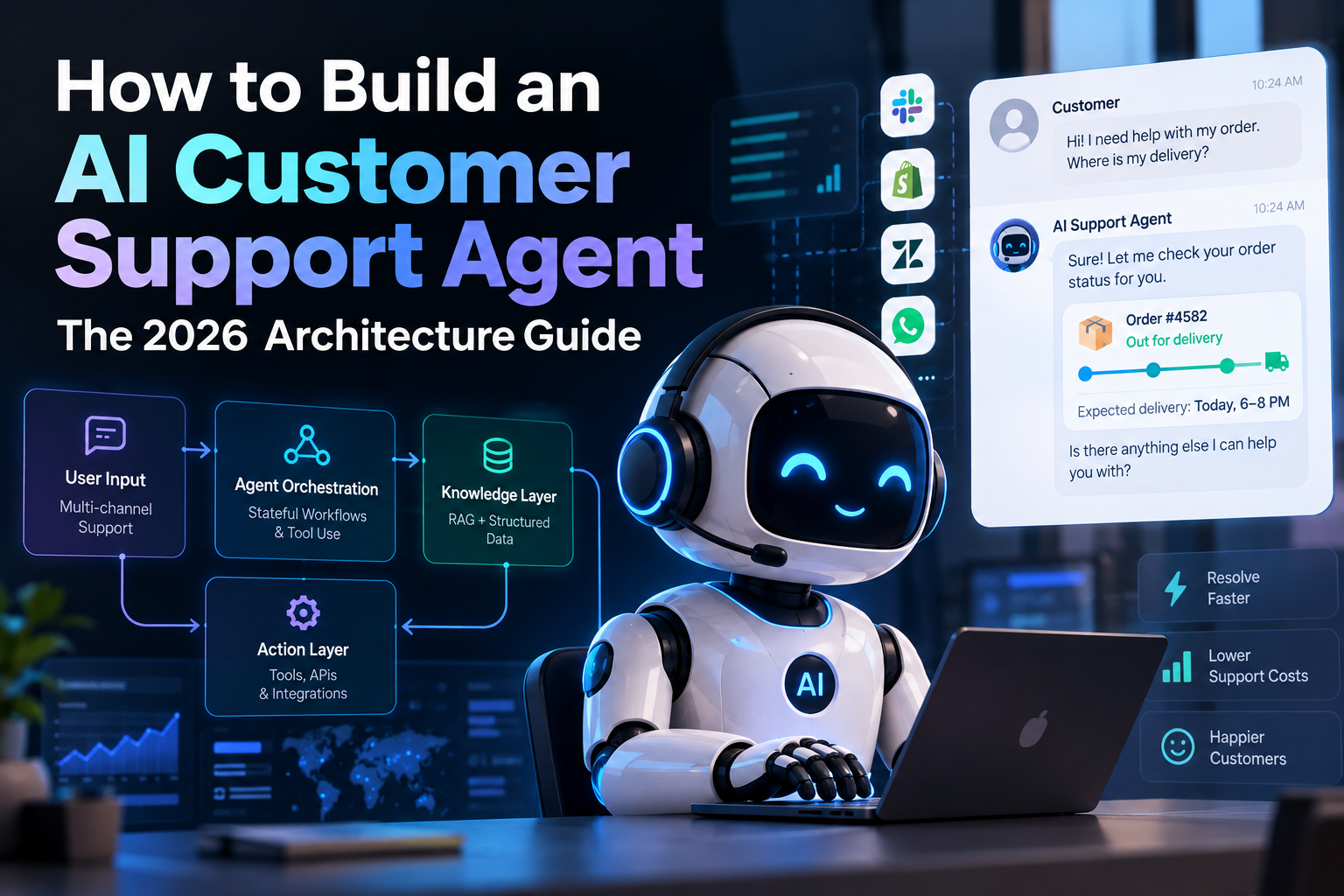
Build a support agent around a narrow customer task, verified information and a reliable handoff. A useful first release might retrieve an order status and prepare a checked response instead of handling every support category.
Deflection and resolution are different
Deflection counts contacts that do not reach a person under a defined measurement method. It does not prove the customer’s problem was solved. Track repeat contact, corrections and customer feedback when evaluating resolution.
Four layers of AI customer support architecture
- 1. Stateful orchestration: Keep the ticket identity, completed steps and pending approvals in a controlled state. Set limits on retries and execution time so the workflow cannot loop indefinitely.
- 2. Tool integration: Use narrow APIs or approved MCP connections. Support agent tool permissions should enforce customer and tenant boundaries outside the model. Treat instructions inside tickets as untrusted input.
- 3. Retrieval: A RAG customer support workflow retrieves relevant policy or account information before drafting. Check version, access and relevance.
- 4. Controlled execution: Validate tool arguments and business rules. Use safe retries, check uncertain writes and require approval for consequential operations.
Design human handoff for AI support first
Send staff the original request, relevant sources, attempted actions and escalation reason. Preserve context when a customer asks for a person. Do not make the user repeat information simply because the automation reached its limit.
Frequently Asked Questions
What does a production support agent need?
A production support agent needs authorized data access, bounded tools, input validation, a usable human handoff and monitoring. It also needs testing against representative requests and failure cases. The precise controls depend on the task, particularly whether the agent only drafts responses or can change customer records and transactions.
Is RAG enough to prevent incorrect support answers?
No. Retrieval gives a model relevant information, but sources can be outdated, incomplete or inappropriate for the customer. Check access, policy version and relevance, then evaluate the resulting answer. When the retrieved material does not support a response, the workflow should ask for clarification or route the case to staff.
Does every support agent need GraphRAG?
No. Graph-based retrieval can be useful when relationships between entities are central to the task, but it adds implementation and maintenance work. Begin with retrieval suited to your source material and measure answer quality. Introduce additional complexity only when testing shows that it solves a specific retrieval problem.
How do you measure support agent quality?
Measure correct resolution, repeated contacts, escalation quality and staff correction time alongside speed and cost. Review results by request type so easy questions do not hide serious failures. A low handoff rate is not sufficient evidence of quality if customers receive inaccurate answers or must contact support again.