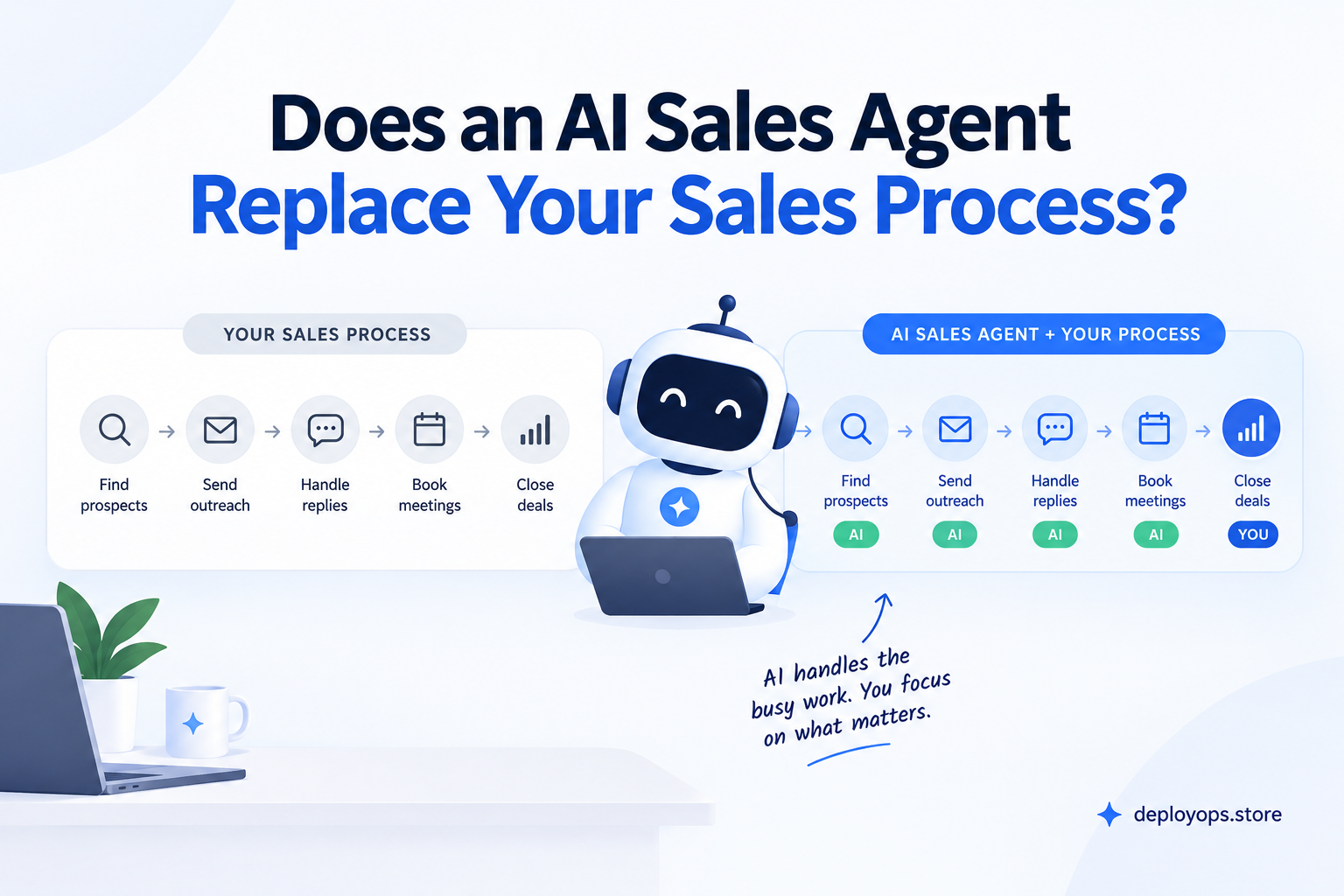
An AI sales agent replaces typing and repetitive research, not your sales process. It needs a defined ideal customer profile, clean data and approved messaging going in. It needs a named person who owns each step. And it needs a human to review anything sensitive before it reaches a prospect. Teams that skip those three things send more emails and book fewer meetings.
Most teams ask the wrong question about AI outbound. They ask whether an agent can replace a person. A better question is which parts of your sales process an agent can run, which parts it can only draft, and which parts must stay with a named human.
This guide answers that with a readiness check you can try on the page, a task board for your own workflow, and the email rules that apply the moment an agent sends a cold message.
What is an AI sales agent?
An AI sales agent is software that uses large language models to carry out parts of outbound selling: finding target accounts, researching contacts, drafting and sending outreach, reading replies and booking meetings. You will also see the same idea sold as an AI SDR, an AI SDR agent or AI sales automation. The labels overlap, and vendors use them loosely.
A useful working split looks like this. An AI SDR agent covers the top of the funnel, meaning prospecting, first outreach and handoff to a rep. An AI sales agent can cover a wider loop that includes multi step follow up and meeting booking. Both depend on the same raw materials your team already uses: your data, your messaging and your target list.
The category is crowded. A 2026 Belkins study reported that G2 listed 397 products in its AI SDR category as of September 2026, ranging from single reply handlers to fully autonomous platforms.
The appeal is time. Gartner research cited by LeanData found that a human B2B seller spends roughly 14 percent of the week prospecting, while an agent can run prospecting work every hour of every day. That is a real gain for research and repetition. It says nothing about whether an account deserves attention or what you are willing to promise.
An AI sales agent replaces effort, not the process
Your sales process is the set of decisions behind the activity: who you target, what you say, who approves what, and how a warm prospect reaches a person. An agent executes steps inside that process. It does not invent one that works.
LeanData makes the same point from the vendor side. An agent will not lift your numbers on its own, and prospects who already ignore your reps will ignore the agent just as readily. High volume can hide a weak reply rate for a while, so fix the underlying motion first and then scale it.
Buyers appear to agree. In the Belkins study, “AI assisted with human review” was the most common answer for 10 of the 13 execution tasks asked about, and fully autonomous use never passed 20 percent on any single task. The closest were data enrichment at 20 percent and list building at 19 percent.
Speed also cuts the other way. A human SDR sending bad outreach is a slow problem. An agent sending bad outreach is a fast one, and it reaches more people before anyone notices.
The inputs an AI SDR agent needs before it starts
Apollo’s guidance on AI SDR workflows lists four inputs: a defined ideal customer profile, clean enrichment data, grounded messaging context and a human escalation path. We cover the first three here and the escalation path in the ownership section.
A written ideal customer profile
Define industry, company size, buyer role, trigger events and exclusions. If your ideal customer profile lives in one person’s head, the agent will guess, and it will guess confidently. Write down who is a fit, who is not, which signals matter (hiring, funding, a tech stack change, a recent post) and which accounts are off limits.
Clean, sourced data
An agent reading a messy CRM does not fix the mess. Verify email addresses before anything is sequenced, keep a suppression list, and require a source for every contact and every claim. LeadMagic’s setup guidance adds a firm rule: never let the agent create contacts from vague search prompts without source attribution.
Approved messaging
Document your approved value propositions, the claims that need sign off, the data sources the agent may use and the actions that require review. The agent should never invent facts, quote prices or make commitments on security, legal or procurement. If a sentence cannot be traced to approved copy or a cited source, it should not be sent.
Who owns each step of AI sales automation
Someone has to own the list, the messaging rules and the follow up. If an agent sends a bad email, “the AI did it” is not an answer your prospect, your customers or a regulator will accept. The FTC states that even if you hire another company to handle email, you cannot contract away your legal responsibility.
| Step | Owner | Signs off on |
|---|---|---|
| Ideal customer profile and target accounts | Sales leader or founder | Who is in, who is out |
| Data quality and suppression | RevOps or whoever runs the CRM | Verified emails, opt outs, do not contact list |
| Messaging and claims | Founder, marketing or sales lead | Value propositions, proof points, what cannot be promised |
| Replies and handoff | SDR or account executive | Everything after a positive reply |
| Compliance | A named person (founder, ops or counsel) | Sender identity, unsubscribe handling, regional rules |
| Results review | Sales leader | Weekly metrics and the decision to pause |
Decisions that still need human review
Before anything is sent
- Whether an account is actually worth pursuing.
- The first message to a named account or an executive contact, which Apollo recommends keeping behind human approval.
- Anything touching a sensitive subject, such as layoffs, a lawsuit or a personal detail.
After someone replies
Positive intent, objections and pricing questions should move to a person. LeadMagic’s hard rules include no agent replies after positive intent without a human handoff. A prospect who says yes to a conversation has just told you the stakes went up.
Decisions to never delegate
Pricing, exceptions, security or legal commitments, and the call to stop contacting an account all stay with people. These are judgment calls with real consequences, and an agent has no standing to make them for you.
AI SDR vs human SDR: where each is stronger
The comparison is not a contest. Each side is strong where the other is weak, which is why teams that get results tend to pair them.
| Area | AI sales agent | Human SDR |
|---|---|---|
| Research at scale | Fast and consistent when data is clean | Slower, but notices context a tool misses |
| Volume and follow up | Runs around the clock | Limited by working hours |
| First draft personalization | Good when grounded in sourced data | Better at tone and timing |
| Reading nuance | Can misread intent or sarcasm | Strong |
| Handling objections | Needs a handoff | Strong |
| Building trust | Limited | Strong |
| Cost of a bad send | Fast and wide | Slow and narrow |
How much review is enough for an AI SDR?
Start with full review and loosen it only when the numbers earn it. The path described in LeadMagic’s guidance runs from 100 percent human review to 50 percent sampled review, then to exception review for high risk accounts, with random quality checks every week. Trellus gives the same advice in fewer words: start with a human in the loop and expand autonomy after quality is proven.
Move the slider to see what each level means in practice.
Pick a stage
Cold email rules still apply when an AI sends it
Cold email is legal in the United States under the CAN-SPAM Act, which is an opt out law. You do not need consent to send the first message, but you must follow the rules, and sending through an agent does not change who is responsible.
The law makes no exception for business-to-business email.
FTC, CAN-SPAM Act: A Compliance Guide for Business
- Use accurate sender, reply and routing information that identifies who sent the message.
- Do not use deceptive subject lines.
- Include a clear way to opt out, and honor opt outs within 10 business days.
- Never sell or transfer the address of someone who opted out.
Penalties can reach $53,088 per violating email, according to CookieYes citing FTC figures. Prospeo reports that the FTC and DOJ announced a $2.9 million CAN-SPAM penalty against Verkada in August 2024. If you email people in the EU or Canada, GDPR and CASL add stricter requirements, so CAN-SPAM compliance alone is not enough. This section is general information, not legal advice, so confirm your setup with counsel.
How to evaluate AI SDR software and AI sales automation tools
Do not buy because a product appears on a best AI list. Ask vendors to show the following on live data, not a screenshot.
- Where each contact and each claim in a draft comes from, with a visible source.
- Approval controls that you can set per account tier, and a log of who approved what.
- Suppression lists and opt out handling that stop the agent automatically.
- Reply routing that sends positive, negative and legal replies to a person.
- Reporting on positive replies, meetings, bad drafts and overrides, not only emails sent.
This is also where research quality matters. A researched prospect brief, with sourced facts about the account, gives your reviewer something concrete to check. A generic lead record gives them nothing to verify, so review becomes guesswork. That difference is the idea behind OutboundOS.
A 30 day rollout for an AI sales agent
Week 1: set the inputs
Write the ideal customer profile, clean and verify the list, build the suppression list, and approve the messaging and claims. Name the owner for each step.
Week 2: run a supervised pilot
Let the agent research and draft. A person approves every message. Record how often you edit or reject a draft and why.
Week 3: sample the review
If drafts are consistently good, move to sampled review, with full approval kept for named accounts and executives. Keep the escalation rules on.
Week 4: judge the results
Compare positive replies, meetings and override rates with your previous outbound motion. Decide whether to expand, hold or pause. Treat the result as a decision for the owner of results review, not for the agent.
Frequently asked questions
Does an AI sales agent replace SDRs?
Not fully. An agent can run research, data enrichment, first drafts and follow ups. People still own target selection, sensitive messages, replies after positive intent, pricing and any legal or security commitment. Most teams that report good results keep their reps and move them toward conversations and judgment calls.
What is an AI SDR agent?
An AI SDR agent is software that handles top of funnel sales development work, such as prospecting, first outreach and handoff to a human rep, using large language models and your data. It differs from an AI sales agent mainly in scope, since the second term often covers follow up and booking as well.
What should an AI sales agent automate first?
Start with prospect research, contact enrichment and verification, first draft messages and follow up reminders. These tasks are repetitive, measurable and easy for a person to review. In the Belkins study, data enrichment and list building came closest to running without review.
Is cold email legal when an AI sends it?
In the United States, CAN-SPAM allows cold email to business recipients when you use honest sender details, include a working opt out and honor opt outs within 10 business days. The same rules apply whether a person or an agent sends the message. Rules in the EU and Canada are stricter. This is general information, not legal advice.
How do I measure whether an AI sales agent works?
Track positive replies, meetings booked, the share of drafts that were bad and how often a human overrides the agent. Compare them with your outbound results before the agent. More emails sent is not a success measure on its own.
When can the agent send without approval?
Only after a pilot with full review shows consistent quality. Even then, keep human approval for named accounts, executive contacts and sensitive topics, and keep random quality checks running every week.