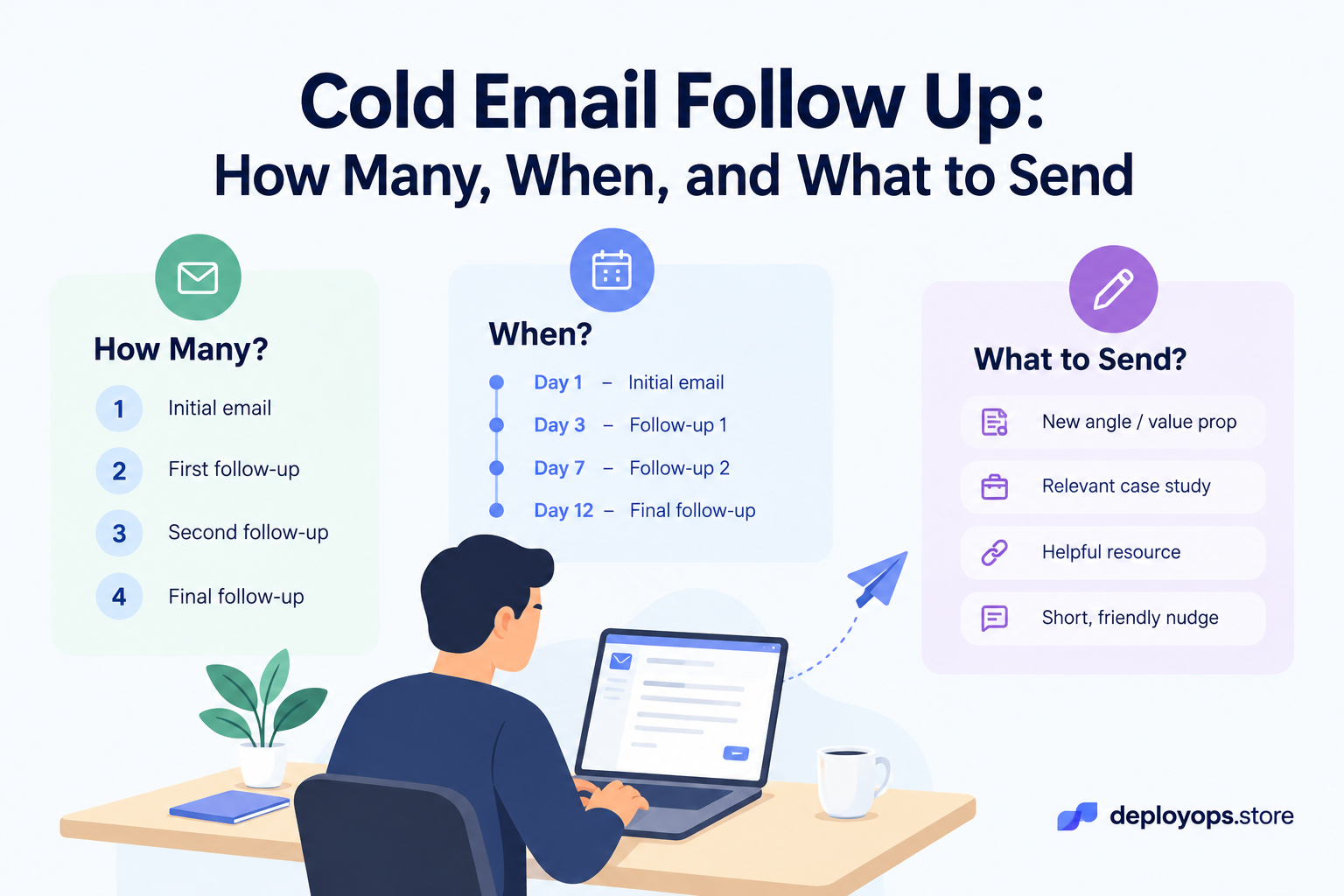
Most replies to outbound email arrive after the first message. This guide covers how many follow-ups to send, how far apart to space them, and what each one should say, with a cadence planner and templates you can use today.
Send 3 to 5 emails in total: the first message plus 2 to 4 follow-ups. Wait at least 2 days before the first follow up, then space the rest 3 to 5 days apart. Give each follow up a new angle or a piece of value, keep it to one ask, and stop when the prospect says no. In one large dataset, 58.6% of replies came from follow-ups, and returns faded after about the fifth email.
Why one email is not enough
A cold email follow up is any message you send after your first email when the prospect has not replied. You will also see it written as follow-up, followup, or cold email followup. The reasoning is simple. Your first message may land on a busy day, sink under newer mail, or reach the person before the problem you solve feels urgent. A second or third touch gives the same offer more chances to arrive at a useful moment.
That logic is easy to accept and hard to act on, because following up feels pushy. The data is a useful corrective.
What the data says
Belkins, a B2B outreach firm, analyzed 7,530,489 emails sent over twelve months. Follow-ups produced 58.6% of all replies, and the first email produced 41.4%. The first email had the best reply rate of any single step at 0.59%. Later steps convert at lower rates, but there are several of them, so together they add up to more than the opener.
Chart
Where replies come from
First email 41.4%
Follow-ups 58.6%
Steps 1Steps 2 to 6
Step 1
0.59%
Step 3
0.30%
Step 4
0.34%
Step 6
0.28%
Source: Belkins, 7,530,489 emails over 12 months. The write-up reports these four steps in its text. Steps 2 and 5 are not stated there, so they are left out instead of estimated.
Woodpecker’s campaign data points the same way. Campaigns with no follow up averaged about a 9% reply rate, and campaigns with at least one reached about 13%. Woodpecker also reports that the first follow up gets a reply rate roughly 40% higher than the initial email. It does not publish the sample size behind those figures, so read them as directional.
The small rise at step 4 in the Belkins data (0.34%, against 0.30% at step 3) is a useful detail. The authors link it to a distinct angle in that message. It fits the main advice in this guide: a follow up that adds something new tends to do better than a repeat of the first email.
Where the sources disagree
Three widely read guides give three different answers on length. The table puts them side by side.
| Source | Recommendation | Data basis |
| Belkins | 3 to 5 steps in total | 7,530,489 emails from its own outreach operations |
| Woodpecker | 2 to 3 follow-ups | Its own campaign data, sample size not stated |
| lemlist | 4 to 9 follow-ups | Its analysis of its own campaigns |
The ranges overlap more than they look. Belkins counts the first email as step 1, so its 3 to 5 steps equal 2 to 4 follow-ups, and Woodpecker’s 2 to 3 sits inside that. lemlist is the outlier. Its author, Rémi Kokabi, co-founder of GTM Club, writes in the lemlist guide:
“In cold sales outreach, you should send between 4-9 follow-up emails.”
Rémi Kokabi, co-founder of GTM Club, in lemlist’s guide to cold email follow-ups
Both lemlist and Woodpecker sell sequencing software, so weigh their numbers with that in mind. Even lemlist warns that returns turn negligible past 9 follow-ups and that you risk being marked as spam.
How many cold email follow up messages should you send?
Plan 3 to 5 emails in total. For most B2B lists, start with four: the first email and three follow-ups. That sits inside every range above except the far end of lemlist’s, and it leaves room to adjust once you have your own numbers. Raise the count only when your list is small and high value, and only while your complaint rate stays low.
Track three numbers for every step of a sequence:
- Reply rate by step. If step 4 adds almost nothing over step 3, cut it.
- Opt-outs and spam complaints. A rising rate on later steps is a signal to shorten the sequence.
- Bounce rate. A high rate usually means a data problem, and more follow-ups will only widen it.
Those three numbers tell you more than any benchmark, because the published averages come from different senders, lists, and definitions of a reply.
How long to wait between follow-ups
Woodpecker advises waiting at least 2 to 3 days before each follow up, since sending sooner can “look pushy and intrusive.” lemlist suggests 2 days between the first and second email, 4 days between the next two pairs, and 5 or more days after the fourth, so a full sequence runs 10 to 25 days. Woodpecker also found that the day of the week had only a slight, non-significant effect on follow-up opens and replies, so do not spend long hunting for a magic weekday.
Use the planner below to turn that guidance into real send dates.
Try it
Cold email follow up cadence planner
Pick a start date, a pace, and how many follow-ups you want. The dates update as you change them.
First email date
PaceSteady: 2, 4, 4, 5 daysTight: 2, 3, 3, 4 daysPatient: 3, 5, 7, 7 days
Follow-ups: 3
Skip weekends (move sends to Monday)
- Fri, Oct 16First emailPersonalized openerstart
- Mon, Oct 19Follow up 1Short bump+3 days
- Fri, Oct 23Follow up 2New angle+4 days
- Tue, Oct 27Follow up 3Closing note+4 days
4 emails over 11 days. Inside the range most sources recommend.
What to say in a follow up cold email
A good follow up gives the prospect a reason to read a second time. Five habits cover most of it:
- Add something new. Use a different angle, a piece of evidence, or a smaller ask. Repeating the first email with “bumping this” gives the reader nothing to react to.
- Keep it short. A few sentences that fit on one phone screen without scrolling.
- Make one ask. A call, a reply, or a yes or no. Two asks split attention and lower the odds of either.
- Anchor it in something real. A hire, a launch, a post, or a funding round. A first name swapped into a template is not personalization, and prospects spot it quickly.
- Make the last email an easy exit. A closing note that lets the person say no costs you little and often earns a short reply.
The research step carries the sequence. When the opening line is specific to the person, each follow up has something true to build on. When it is generic, every later message has to work harder.
Follow up cold email templates you can copy
The builder below holds a sample cold email and four follow up templates. Fill in the five fields and every message updates. The values shown are examples, so replace them with details from your own research on each prospect.
Try it
Sample cold email and follow up cold email template builder
Prospect first name
Your name
Your company
What you noticed
Outcome you help with
First emailFollow up 1Follow up 2Follow up 3Closing note
Subject: Quick question about ramping new reps faster
Hi Priya,
I noticed your team opened three SDR roles. Teams in that position often run into trouble with ramping new reps faster.
Northwind Analytics helps with exactly that. Would a 15 minute call next week be useful?
Alex
Copy emailSend: Day 1
Subject line for cold email follow-ups
For a follow up, the simplest cold email subject is a reply in the same thread, so the subject starts with Re: and your earlier message stays visible. Switch to a fresh subject when you change angle, usually at the second or third touch. Keep every subject line for cold email specific to the prospect’s situation and free of all caps. Do not add a fake Re: to a first email. It misleads the reader, and US CAN-SPAM rules prohibit deceptive subject lines.
Mistakes that make a cold email followup fail
- Sending too soon. A second email the next morning reads as pressure. Give the first at least 2 days.
- Sending the same email again. A follow up with no new information is easy to delete.
- Sending too many. In the Belkins data, volume falls sharply after the fifth step, and long sequences raise spam risk.
- Ignoring a no. Stop at once when someone opts out or says they are not interested.
- Skipping research. The wrong person with the right message still fails. Check role and fit before you write.
- Using one template for every list. Different segments care about different problems, so the angle should change with them.
Where software helps and where a person should decide
Follow-ups are repetitive, which is why teams automate them. The parts that need judgment are who to contact, which angle is true for that company, and when to stop. Those are the parts to keep under human control.
OutboundOS is built around researched prospect briefs, so each message starts from something real about the person instead of a name dropped into a template. If you want to see how that works on your own prospect list, you can book a demo.
Cold email follow up FAQ
How many follow-up emails should I send after a cold email?
Plan 3 to 5 emails in total, which means the first email plus 2 to 4 follow-ups. Belkins recommends 3 to 5 steps, Woodpecker recommends 2 to 3 follow-ups, and lemlist suggests 4 to 9 follow-ups. In the Belkins data, reply volume falls sharply beyond the fifth step.
How long should I wait before sending a cold email follow up?
Woodpecker advises waiting at least 2 to 3 days before each follow up. lemlist suggests 2 days after the first email, 4 days after each of the next two, and 5 or more days after the fourth, so a full sequence runs 10 to 25 days.
Should a follow up cold email use the same subject line?
Replying in the same thread keeps your earlier message visible, so the subject starts with Re:. When you change angle, a fresh subject line for cold email follow-ups can work better. Test both on your own list, and never add a fake Re: to a first email.
What should I write in a follow up cold email?
Add something new, such as a different angle, a piece of evidence, or a smaller ask. Keep it to a few sentences with one clear request. Belkins attributes a small reply uptick at its fourth step to a distinct angle in that message.
When should I stop following up?
Stop when the prospect says they are not interested, when they opt out, or after your last planned email. Published guidance caps sequences at roughly 3 to 10 emails depending on the source, and lemlist warns that going past 9 follow-ups risks spam complaints.
Does the day of the week matter for a cold email followup?
Very little in Woodpecker’s data. It found that sending day had only a slight, non-significant effect on follow-up open and reply rates, so spend your effort on the message and the angle first.
What is a good reply rate for cold email?
Published averages vary widely. Belkins reports 0.59% for the first email step across 7,530,489 emails, while lemlist reports about 4.5% for a single email in its own campaigns. Different senders, lists, and definitions of a reply likely explain much of the gap, so compare against your own past sends.
Limits to keep in mind. The sources use different senders, lists, and definitions of a reply, so their rates cannot be compared with each other or with your results. Woodpecker does not state the sample size behind the figures cited here. lemlist’s figures come from its own campaigns. We left out Belkins’ meeting attribution numbers because the figures on the page did not agree with one another. Treat every number as a starting point and test on your own list.