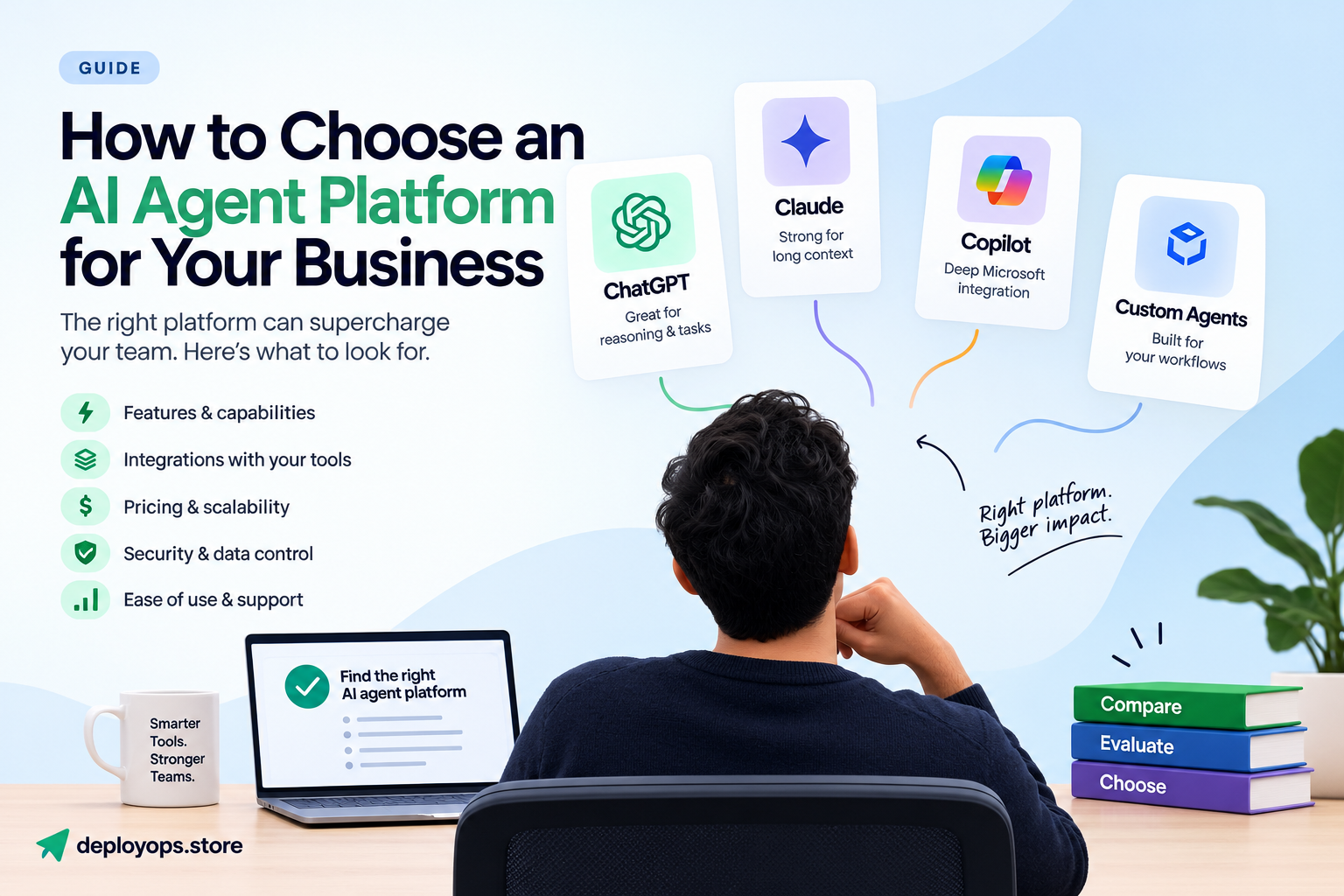
Every software vendor now says it sells AI agents. That makes buying one harder than it should be. The demos always work, and the real differences show up three months later, when the agent meets your messy data and your actual customers.
To choose an AI agent platform, pick the job first. Then match the platform type to who will build and maintain it, how sensitive your data is, and what it costs at your real volume. Most businesses should start with one narrow workflow on a no-code or managed platform, run a 30 day pilot, and move to a developer framework only when they hit a clear limit.
This guide covers what an AI agent platform actually includes, the four types on the market, seven criteria to judge them by, and a pilot plan you can run next month. Three tools below let you apply it to your own business.
What is an AI agent platform?
An AI agent platform is software that lets a business build, run, connect and monitor AI agents. An agent is different from a chatbot. A chatbot answers a question. An agent takes a goal, decides on steps, uses tools such as your email, CRM or database, and acts on the result, often without a person clicking anything.
Most platforms bundle the same six parts:
- Model access. The large language model that does the reasoning, sometimes with a choice of several.
- Tool connections. Integrations that let the agent read and write in your apps.
- Knowledge and memory. Your documents, past conversations and business rules.
- Workflow logic. How steps are ordered, branched and retried.
- Guardrails. Permissions, approval steps and limits on what the agent may do.
- Monitoring. Logs, testing and cost tracking.
When you compare platforms, you are really comparing how well each one handles those six parts for your use case. Model quality matters less than most demos suggest, because many platforms let you swap the model underneath.
Why choosing an AI agent platform carefully matters
The market is crowded and the failure rate is high. Gartner predicts that over 40% of agentic AI projects will be canceled by the end of 2027, citing escalating costs, unclear business value or inadequate risk controls. It also estimates that only about 130 of the thousands of agentic AI vendors are real. The rest are doing what Gartner calls agent washing: relabeling chatbots and ordinary automation as agents.
Most agentic AI projects right now are early stage experiments or proof of concepts that are mostly driven by hype and are often misapplied.
Measurement is the other gap. A Liferay study reported by CMSWire found that 54% of companies are running AI agents, yet only 25% measure their impact. If you cannot measure the agent, you cannot tell whether the platform is working. That is why the criteria below put testing and cost tracking right next to features.
The four types of AI agent platforms
Platforms fall into four groups. The lines blur, and many vendors straddle two, but the grouping tells you what you are signing up for.
| Type | Examples | Best for | Trade-off |
| No-code builders | Zapier Agents, Lindy, Relevance AI | Non-technical teams automating one or two workflows fast | Less control over logic and data handling |
| Managed platforms | Microsoft Copilot Studio, Google Vertex AI Agent Builder, Amazon Bedrock Agents | Mid-size and large teams that want hosting, security and support included | Tied to one cloud, and costs scale with usage |
| Open source and developer frameworks | LangGraph, CrewAI, Dify, n8n | Engineering teams that need full control or self-hosting | You own maintenance, security and upgrades |
| Agents inside your existing software | Salesforce Agentforce, ServiceNow, Workday | Companies already standardized on one suite | Strongest inside that suite, weaker across others |
A no code AI agent platform is the fastest way to learn. Teams often get a first agent live in days. The catch is the ceiling: when you need custom approval logic, strict data residency or deep system integration, you may outgrow it.
A managed AI agent platform handles hosting, scaling, security patches and often compliance paperwork. You pay for that convenience, and you accept the vendor’s way of working.
An open source AI agent platform gives the most control and can run inside your own network. It also hands you the on-call pager.
If your customer data already lives in one suite, the agent built into that suite can be the lowest-risk choice, because permissions and data do not have to move.
Find your AI agent platform type
Answer five questions. The matcher scores each platform type for your situation. The answers below are examples, so change them to match your business.
Interactive tool / Platform matcher
Who will build and maintain the agent?
A non-technical team
Operations with some IT help
Dedicated developers
How sensitive is the data the agent will touch?
Low, mostly internal
Customer personal data
Regulated (health, finance)
What is the job?
One repeatable task
Several workflows across teams
A feature customers will use
How fast do you need it live?
In days
In weeks
Months are fine
Where do your tools live?
Mostly one software suite
Many separate apps
Custom internal systems
How to choose an AI agent platform: 7 criteria that matter
1. Start with one job, not a platform
Write the job as a sentence: “Answer order status questions and issue refunds under a set limit.” A clear job tells you which integrations, permissions and tests you need. Teams that start with “we need an AI strategy” tend to buy features they never use. Pick a task that is frequent, rule-based enough to test, and low-risk enough that a mistake is recoverable. Support triage, lead qualification, invoice matching and meeting follow-ups are common first picks.
2. Check the integrations you actually use
An agent is only as useful as the systems it can reach. List the five tools it must read from or write to, then check each one for a native connector, not just a generic API option. Ask what happens when a connection breaks. Silent failures are the most expensive kind.
3. Match the platform to the people who will maintain it
Building is the easy part. Someone must update prompts, fix broken workflows and review failures every week. A no-code tool fits an operations team. A framework fits engineers. If nobody owns the agent after launch, it will drift and quietly get worse.
4. Look hard at data security and compliance
Ask where your data is stored, whether your inputs are used to train models, and which certifications the vendor holds, such as SOC 2 or ISO 27001. If you handle personal data in the UK or EU, check how the platform supports your GDPR duties. In India, check how it aligns with the Digital Personal Data Protection Act. In the US, ask about HIPAA if you handle health data. For regulated data, involve your compliance lead before the demo, not after.
5. Demand human oversight and guardrails
Good platforms let you set what an agent may do alone and what needs approval. Refunds, deletions, outbound emails to customers and anything involving money should start with a human sign-off. Loosen the rules only after the agent earns it in the logs.
6. Insist on testing and visibility
You need to see every step an agent took, including which tools it called and why. You also need to test changes against past cases before they reach customers. Platforms with built-in evaluation and audit logs save weeks of guesswork. Most buyers skip this criterion, and the Liferay figure above suggests most companies are paying for it later.
7. Model the price at your real volume
AI agent platform pricing comes in three common shapes: per seat, per usage (tokens, runs or credits) and per outcome (such as a resolved ticket). Each behaves differently as you grow. Seat pricing is predictable but wasteful for light users. Usage pricing is cheap in a pilot and surprising in production. Ask for a cost estimate at ten times your pilot volume, and ask whether you can set spending caps and alerts.
Best AI agent platform for small business vs enterprise
For a small business
Small teams should favor speed and low maintenance. A no code AI agent platform, or an agent inside software you already pay for, usually wins. Avoid platforms that need developers unless you have one. Start on a monthly plan, not an annual contract, until the pilot proves value.
For an enterprise
Larger companies should weigh governance first: single sign-on, role-based permissions, audit logs, data residency and vendor support. A managed platform or an agent in your core suite usually fits. Expect procurement and security review to take longer than the build. Measurement matters most here, because many agents across many teams can turn into sprawl that nobody tracks.
Five mistakes that sink AI agent projects
- Buying on the demo. Demos use clean data. Ask to test with your own messy cases.
- Automating a broken process. An agent speeds up whatever it is given, including errors. Fix the process first.
- Skipping an owner. Name one person who is accountable for the agent’s results.
- Granting full autonomy on day one. Start with approvals and relax them as the logs earn your trust.
- Ignoring exit costs. Ask how to export agents, prompts and logs if you leave.
A 30 day pilot plan for your AI agent platform
A short pilot is the cheapest way to compare platforms. This is a real sequence, so follow it in order.
- Week 1, define. Pick one job. Write the success measures (time saved, error rate, cost per task) and record a baseline of how the work is done today.
- Week 2, build. Build the agent with human approval on every action. Collect 50 to 100 real past cases to test against.
- Week 3, shadow. Run the agent alongside your team without sending anything to customers. Compare its output to what people did, and fix the failures that repeat.
- Week 4, go live small. Release it on a small share of real work with spending caps. Compare results to your baseline, then expand, adjust or stop.
Stopping is a valid result. A pilot that ends a bad purchase early has already paid for itself.
Choosing an AI agent platform is less about finding the best product and more about finding the best fit for one job, one team and one risk level. Use the matcher to narrow the field, the checklist to compare vendors fairly and the calculator to test the economics. Then run the pilot and let your own results decide.
AI agent platform FAQ
What is the best AI agent platform for business?
There is no single best AI agent platform for business. The right choice depends on the job, your team’s technical skills, how sensitive your data is and your budget. No code builders suit small teams, managed platforms suit mid-size and large companies, and open source frameworks suit engineering-led teams.
What is the difference between an AI agent and a chatbot?
A chatbot answers questions. An AI agent takes a goal, decides on steps, uses tools such as your CRM or email, and acts on the result, often without a person clicking anything.
Do I need developers to use an AI agent platform?
Not always. A no code AI agent platform lets operations or marketing teams build agents with visual tools. You need developers for custom integrations, self-hosting or customer-facing product features.
What is a managed AI agent platform?
A managed AI agent platform is a hosted service where the vendor runs the infrastructure, security updates and scaling. You configure the agents and the vendor keeps the system running. The trade-off is less control and some vendor lock-in.
How much does an AI agent platform cost?
Prices vary widely and change often. Common models charge per seat, per usage or per outcome. Ask each vendor for an estimate at your expected volume and at ten times that volume, and check whether you can set spending caps.
How long does it take to see results?
A focused pilot of about 30 days on one workflow is enough to see whether an agent saves time or money. Broad rollouts across many teams take longer.
What is agent washing?
Agent washing is when vendors relabel chatbots, assistants or simple automation tools as AI agents. Gartner estimates that only about 130 of the thousands of agentic AI vendors are real, so test any claim against your own use case