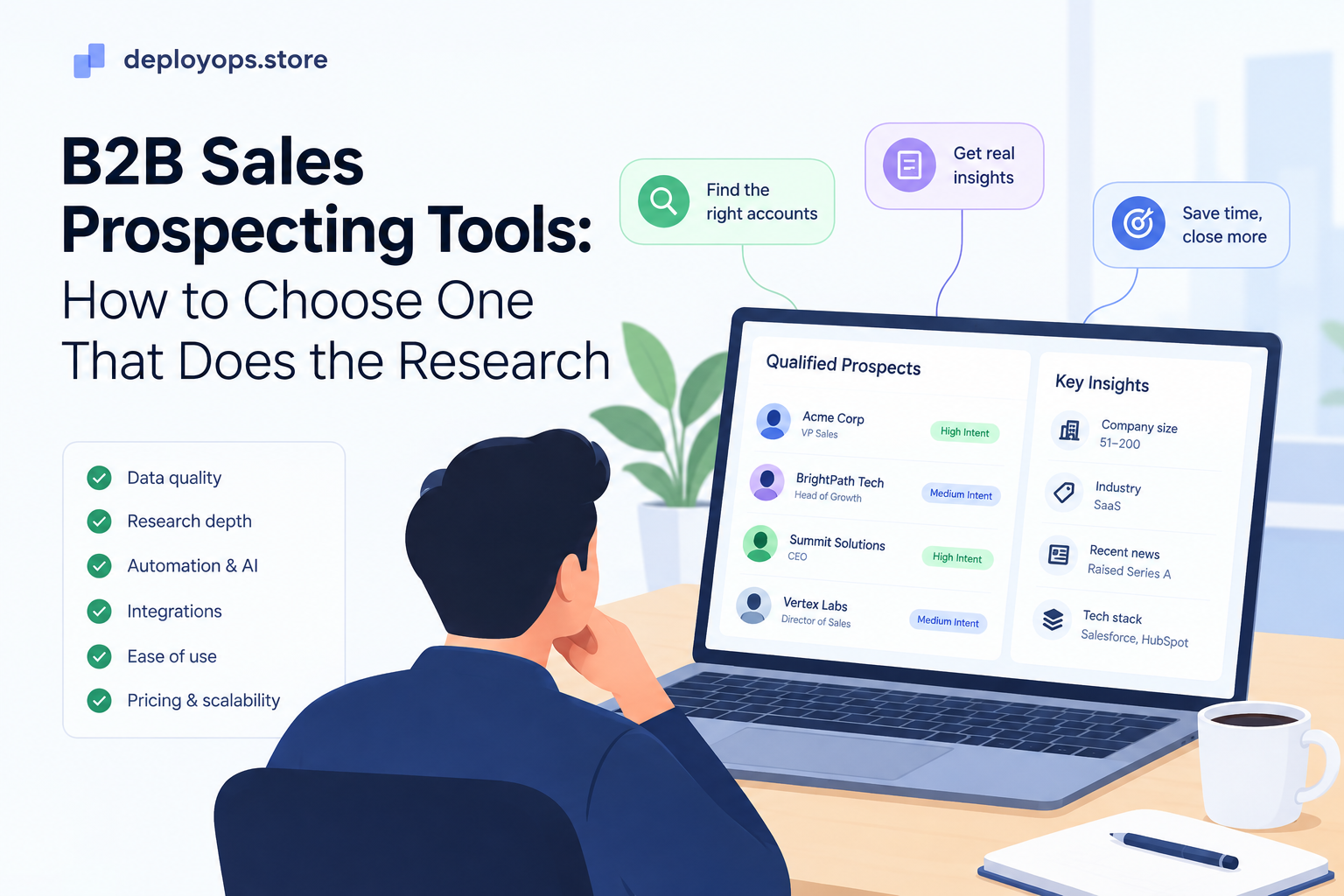
The best B2B sales prospecting tools find the right accounts, verify the contact and tell the rep why to reach out today. Most tools stop at the contact. If your team still writes first lines from a name, a title and a company, look for a tool that produces a researched brief for every prospect, then judge it by reply rate, not by list size.
Open any ranking of B2B sales prospecting tools and the pattern repeats. The lists run from 7 to 56 products, and each entry leads with database size, integrations and price. Hardly any explain how much real research the rep receives before the first message goes out. That missing piece decides whether outreach gets replies.
This guide covers what these tools do, where AI helps, what an AI prospecting agent can and cannot do, and how to choose. You will find a short quiz, a five-step workflow and a calculator for the research time your team could win back.
Disclosure: OutboundOS makes outbound sales software, so we have an interest in this topic. We cover the whole category and link every statistic to its source at the end.
What prospecting tools do, and the four types
A prospecting tool helps a sales rep find potential customers, learn about them and get in touch. In practice, B2B sales prospecting tools fall into a few groups, and most teams use more than one. Whether you are comparing them or searching for the best AI prospecting tools, start by naming the job you need done.
| Type | Main job | Examples in published roundups |
|---|---|---|
| Contact and intent data | Finds accounts, verified contacts and buying signals | ZoomInfo, Cognism, Lusha |
| Relationship search | Finds people by role, company and network | LinkedIn Sales Navigator |
| Engagement and sequencing | Sends and tracks multi-step outreach | Outreach, Salesloft |
| CRM and agent platforms | Scores leads and drafts outreach inside the CRM | HubSpot Sales Hub, Salesforce Agentforce |
| All-in-one platforms | Data plus outreach in a single product | Apollo.io |
Examples come from published roundups and are not an endorsement or a ranking.
Notice what the table leaves out. None of those jobs is writing a message that proves you studied this company. Reps still do that by hand, and it is slow. Autobound reports that a personalized email takes the average rep 15 to 20 minutes.
Why a lead record is not enough
A standard lead record holds a name, a title, a company and an email address. A researched prospect brief adds what a rep needs to start a real conversation: what the company does, what changed recently, who else is involved in the decision and a reason to reach out now. Switch between the two using the fictional example below.
Lead record
Fictional example for illustration. Not real company data.
Time is the first cost of skipping that research. Salesforce’s 2023 State of Sales research found reps spent about 28% of their week selling, and a 2026 roundup from SPOTIO reports the newer edition at 40%. In both cases most of the week goes to admin, data entry and research.
Replies are the second cost. Belkins’ 2025 study, as cited by Autobound, put the average B2B cold email reply rate at 5.1%, down from roughly 7% a year earlier. Woodpecker, using different data, reports small, well-researched campaigns reaching up to 18%. The datasets differ, so read that gap as a direction and not as a promise.
Expert view (replace before publishing)
Add a short quote here from your founder or a sales advisor: their name, title and one or two sentences on why generic lead records fail. Link their profile so readers can verify who they are.
AI sales prospecting tools: what changed and what did not
AI sales prospecting tools use machine learning and language models to find prospects, enrich records, score fit and draft outreach. Salesforce reports that 92% of sales professionals already using AI agents say AI benefits prospecting. Gartner, as cited by Instantly, expects B2B sales organizations using AI sales technologies to cut the time spent on prospecting and meeting prep by more than half.
What AI does well
- Enrichment. It pulls firmographic data from third-party providers into one record, so reps stop switching between tabs.
- Ranking. It turns scattered data into a list ordered by fit and buying intent.
- First drafts. It writes a version of the message that a rep can edit instead of starting from nothing.
What AI still gets wrong
Speed creates its own problem. Woodpecker notes that prospects can increasingly tell a research-backed email from an AI merge. A tool that fills in a first name and a company faster is still sending a template. The test for any of the AI sales prospecting tools you shortlist is whether the message contains a fact the prospect would not expect a stranger to know.
What is an AI prospecting agent?
An AI prospecting agent is software that finds, researches and contacts potential customers with some autonomy. Monday.com draws the line this way: an assistant waits for instructions, while an agent spots a prospect from intent signals and decides when to reach out. Rule-based automation follows fixed steps and cannot adapt when the situation changes.
Large platforms now ship their own. HubSpot offers a prospecting agent that researches accounts and drafts outreach. Salesforce’s Agentforce version builds a prioritized list of accounts and contacts inside the CRM, and Salesforce cites Perk saying the agent now builds 60% of its North America SDR-generated pipeline. That result is reported by the vendor, so ask for evidence from teams that look like yours.
Where an AI prospecting agent still needs a human
Agents work best on volume at the top of the funnel. They are weaker at judgment: whether a trigger event matters, whether the tone suits a senior buyer, whether a message should go out at all. A common setup has a person review each draft before anything is sent. The brief gives the rep one place to check the agent’s work.
How to choose the best AI prospecting tools
HubSpot, Salesforce and many vendors publish their own lists of the best AI prospecting tools, and the criteria overlap. These seven checks work for any category in the table above.
- Research depth. Does each prospect get facts specific to their company, or only firmographics such as size and industry?
- Data freshness. Tools that refresh records reduce data decay. Ask how often the data updates.
- CRM fit. It should work with HubSpot, Salesforce or wherever your pipeline lives.
- Review controls. If an AI prospecting agent will contact people for you, require an approval step before sends.
- Compliance. Contact data should be verified and handled in line with GDPR and CCPA.
- Deliverability. SPF, DKIM and DMARC records and a warmed sending domain still matter.
- Measurement. Judge results by reply rate, since open rates are unreliable under email privacy protections.
Sales prospecting tools for lead generation: a five-step workflow
Tools only help when the process around them is sound. The list below adapts the core of Komo’s six-step cold email workflow into five steps for sales prospecting tools for lead generation. Tick each one off as you go.
-
Define your ideal customer profileWrite down the industry, size, role and trigger events that make an account a good fit.
-
Build a verified listPull contacts that match the profile and check that every email address is valid and compliant.
-
Research each account into a briefCapture what the company does, what changed, who is involved and why now, before anything is written.
-
Send personalized messages with follow-upsUse one fact from the brief in the first line, check SPF, DKIM and DMARC, and plan the follow-up sequence.
-
Measure reply rate and reviseCompare a generic version with a researched version on the same list and keep what earns replies.
0 of 5 steps done
Notice where the research step sits: after the list is built and before a single message is written. Skipping it is why many sales prospecting tools for lead generation produce volume without replies.
How much research time could you win back?
Enter your own numbers. The default of 15 minutes per prospect is the low end of the 15 to 20 minutes per personalized email that Autobound reports. The review time is an assumption, so change it to match what you see.
Your team spends about 40 hours a week on manual research. Reviewing ready briefs would take about 13.3 hours. That frees roughly 26.7 hours a week, or about 1,280 hours across 48 working weeks.
Illustrative arithmetic from your inputs, not a benchmark or a promise of results. The yearly figure assumes 48 working weeks.
Where OutboundOS fits
OutboundOS is a managed AI agent subscription for outbound sales. According to its homepage, it researches prospects from verified public sources, drafts personalized multi-step email sequences for review, monitors the inbox weekly, triages replies, syncs the pipeline to a CRM and runs suppression checks.
Two points from this guide apply directly. The drafts come to a person for review, which is the control step recommended above for any agent that contacts prospects. And the homepage says the service suits teams with a clear process owner who can review the output. Run a small test on your own list and measure reply rate before you scale, as you would with any of the best AI prospecting tools.
See the homepage for current features, pricing and terms.
The short version
The best B2B sales prospecting tools do more than hand you contacts. Pick the type that fits your bottleneck. Treat AI sales prospecting tools as a way to research faster, not to template faster. Keep a person in the loop and measure replies. Used that way, sales prospecting tools for lead generation produce conversations and not just lists, and the best AI prospecting tools earn their place by what they put in front of the rep.
About this guide. Written by the OutboundOS team and last reviewed on October 14, 2026. Statistics come from the third-party studies listed under Sources, and some are reported by vendors. Check the original reports before you quote them.
Frequently asked questions
What are B2B prospecting tools used for?
They help sales teams find target accounts, get verified contact details, track buying signals and run outreach. Some also research each account so the first message can be specific. Most teams combine a data source, an engagement tool and a CRM.
Do AI prospecting tools replace sales development reps?
No. Salesforce describes them as augmenting sales development reps, not replacing them. The tools take on research and first drafts. Reps still judge fit, tone and timing, and they hold the conversations that lead to meetings.
What is the difference between a lead record and a prospect brief?
A lead record lists who someone is: name, title, company and email. A prospect brief explains why to contact them now. It adds company context, recent changes, other people in the buying group and a suggested opening line.
How much does personalization improve cold email replies?
Published figures vary by dataset. Woodpecker reports reply rates up to 18% for small, well-researched, personalized campaigns, while Belkins’ 2025 study, cited by Autobound, found a 5.1% average across B2B cold email. Treat the gap as a direction and test on your own list.
How long should prospect research take?
Autobound reports 15 to 20 minutes per personalized email for the average rep. At 40 prospects a week, that is 10 to 13 hours. A ready-made brief should turn that into a short review, which you can model in the calculator above.
Is AI-written outreach safe for compliance and deliverability?
Keep contact data verified and compliant with rules such as GDPR and CCPA, set up SPF, DKIM and DMARC records, warm the sending domain and keep a human review step. AI changes who drafts the message. The legal and technical requirements stay the same.
How do I know if a prospecting tool is working?
Track reply rate as the main metric, since open rates are increasingly unreliable under email privacy protections. Apollo suggests splitting a list in two, sending a generic email to one group and a trigger-personalized version to the other, then comparing replies after five business days.