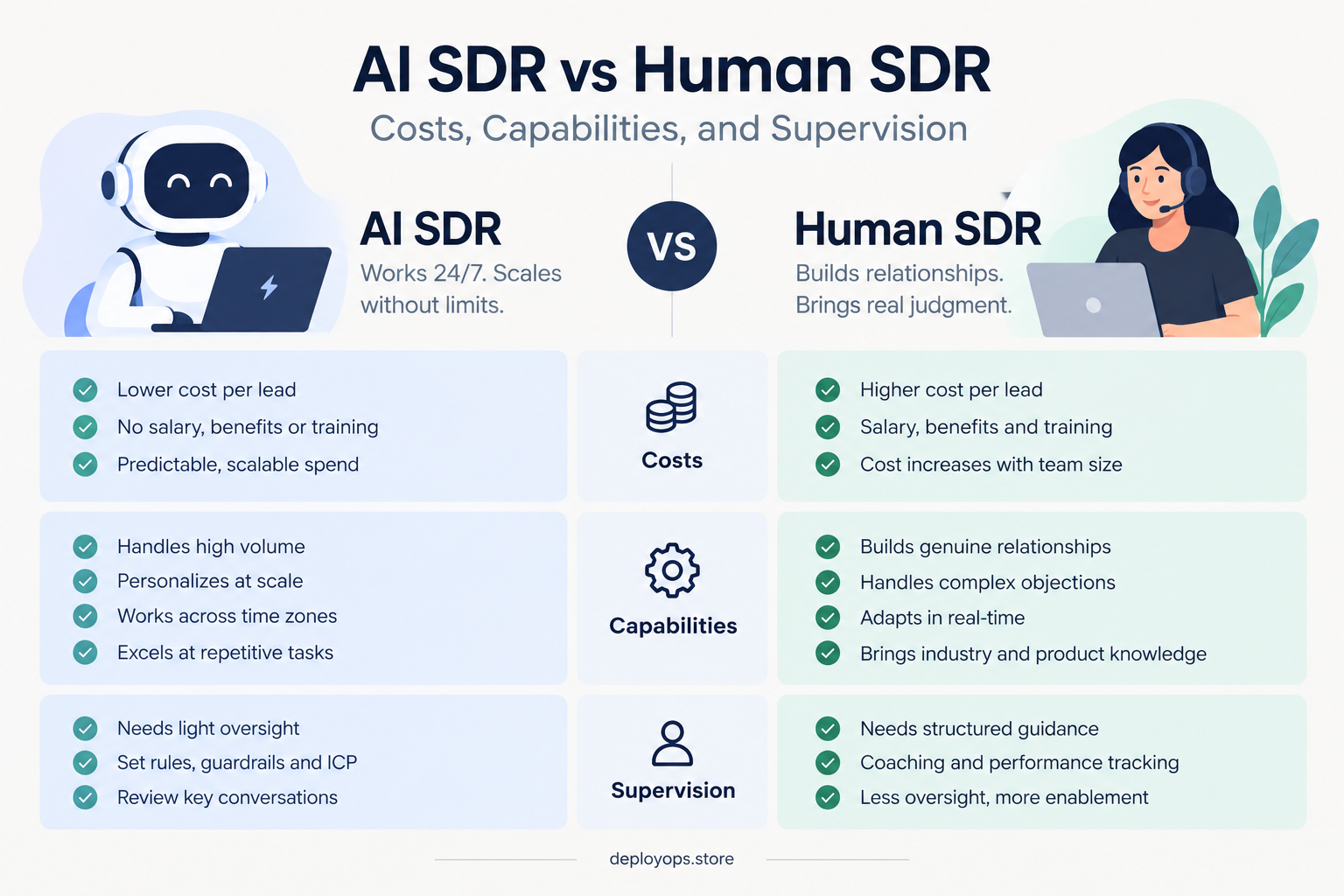
Every outbound team gets pitched an AI sales development representative now. G2 lists nearly 400 products in its AI SDR category , and the promise in every demo is the same: an agent researches prospects, writes the emails and books the meetings for a fraction of a salary.
The fraction is the part worth checking. This guide compares AI SDR vs human SDR cost line by line, shows where each one performs better, and puts a number on the supervision that vendor pages tend to leave out. You can plug your own figures into the calculator in the middle.
Every figure below comes from a named source, listed at the end. Where the source is a vendor, we say so, because vendor benchmarks flatter the vendor.
Key takeaways
- A fully loaded in-house SDR costs about $110,000 to $160,000 a year, with average tenure of 14 to 18 months.
- AI SDR platforms commonly run $18,000 to $60,000 a year before supervision time.
- One well documented deployment reported 15 to 20 hours of human oversight every week.
- The strongest benchmark we found favored a hybrid pod over either pure model.
AI SDR vs Human SDR Cost: Line by Line
What a human SDR really costs
Base pay is the smallest part of the bill. SDR base salaries typically sit between $50,000 and $75,000. Add variable pay, payroll taxes, benefits, tools, management time and recruiting, and published estimates of the fully loaded cost land between $110,000 and $160,000 a year.
Two things inflate that number. The first is ramp. The Bridge Group puts average ramp time at about 3.2 months, and you pay full compensation for partial output while it lasts. The second is churn. The same research reports roughly 45 percent annual turnover and a tenure of 14 to 18 months, so a rep who ramps for three months gives you about a year of full productivity before leaving. Estimates of what each departure costs range from $35,000 to over $90,000, depending on what the author counts.
At 10 to 14 qualified meetings a month, one vendor analysis puts a fully loaded SDR at $821 to $1,150 per qualified meeting.
How much does an AI SDR cost?
AI SDR pricing is wide. One pricing guide puts the range at $100 to more than $10,000 a month, depending on whether you buy a drafting tool or an autonomous agent. Unify, itself an AI SDR vendor, reports platform costs of $18,000 to $60,000 a year across 120 customers.
Published examples help. 11x lists its Growth plan at $3,750 a month billed annually, about $45,000 a year. A competitor review noted that 11x’s own FAQ has stated a lower figure, so get the price in writing before you sign. Artisan quotes by plan, and third party deal data puts typical annual contracts in the low to mid five figures, with larger deployments higher .
The pricing model matters as much as the price. Add sending domains (roughly $10 to $15 a year each), data credits and a warm-up period before the first send, and the sticker price understates the real spend.
| Pricing model | How you pay | Watch for |
| Per seat | Monthly fee per user, plus data credits | Cost climbs with every added user |
| Per lead | Fee for each lead contacted | Volume drives the bill |
| Usage based | Credits spent per action | Spikes in busy months |
| Annual platform fee | Flat contract, often quote only | Multi-year lock-in and auto renewal |
The cost nobody lists: supervision
SaaStr runs one of the most documented AI SDR deployments in public. It reported that its agents needed 15 to 20 hours of human attention every week, and that results rose and fell with the time invested . At an assumed $60 an hour, that is $46,800 to $62,400 a year, which can equal the platform fee. SaaStr also paid for its agents by moving budget away from two human SDR roles, not by finding new money.
Realistic AI SDR cost savings
The savings are real, but they come from volume and ramp time, not from removing people. SaaStr reported that its AI sent more email in one month than its best human SDR sent in over 40 months . If capacity is what holds your team back, an AI SDR cuts cost per meeting. If targeting or offer quality is the problem, it produces the same weak results, only faster. SaaStr’s own warning was that these tools cannot fix what is already broken.
AI SDR Cost Comparison Calculator
Move the sliders to compare a human team, an AI SDR with supervision, and a hybrid. The starting values are example assumptions, not measurements. The numbers you should trust are the ones from your own pilot.
Human team
SDRs on the team5
Fully loaded cost per SDR a year$130,000
Qualified meetings per SDR a month12
Meetings that become opportunities25%
AI SDR setup
Platform cost a year$45,000
Data, domains and tools a year$6,000
Supervision hours a week15 hrs
Cost of an hour of supervision$60
Meetings the AI books a month20
Meetings that become opportunities15%
Human team (5 SDRs)$650,000 a year
Qualified meetings a year
720
Opportunities a year
180
Cost per meeting
$903
Cost per opportunity
$3,611
Total annual cost, scaled to the largest option
AI SDR with supervision$97,800 a year
Qualified meetings a year
240
Opportunities a year
36
Cost per meeting
$408
Cost per opportunity
$2,717
Total annual cost, scaled to the largest option
Hybrid (3 SDRs plus AI)$487,800 a year
Qualified meetings a year
672
Opportunities a year
144
Cost per meeting
$726
Cost per opportunity
$3,388
Total annual cost, scaled to the largest option
The AI setup has the lowest cost per opportunity at $2,717. Supervision is $46,800 a year, or 48% of the AI setup cost.
Hybrid means half the human team, rounded up, plus the AI setup. The opportunity rates of 25 percent for humans and 15 percent for AI come from a 2026 vendor benchmark described below. Annual figures assume a full year and ignore ramp time and turnover, which makes the human column look better than it usually is.
AI SDR vs Human SDR Comparison: Capabilities
Capability is not one score. Split the SDR job into tasks and the picture gets clearer. Use the filter to see who should own each task.
All tasksAI ownsHuman ownsShared
| SDR task | AI SDR today | Best owner |
| Sending first touch email at volume | Strong, runs around the clock | AI |
| Following up on leads your team dropped | Consistent, never forgets | AI |
| Sorting replies (interested, not now, wrong person, unsubscribe) | Reliable on routine replies | AI |
| Researching accounts and building lists | Fast, but needs a human to set priorities | Shared |
| Personalizing each message | Good at scale, needs review for tone and accuracy | Shared |
| Handling objections and pushback | Weak outside simple questions | Human |
| Cold calling | Limited | Human |
| Deciding whether a reply is a real opportunity | Misses nuance in senior buyers’ replies | Human |
| Pricing and negotiation conversations | Should escalate | Human |
Where an AI SDR performs well
The strengths are volume and consistency. An agent can research, write and send to hundreds of prospects a day, in each prospect’s local business hours, without tiring. It follows up on every lead that a busy team lets slip, and it sorts replies into categories in seconds. A human SDR cannot match that on cost or scale.
Where a human SDR still wins
Humans own the moments that need judgment. In a Belkins review, cold calling stayed human-only for 55 percent of teams and objection handling for 57 percent . A senior buyer who writes back by hand, pushes on price or hints at a budget cycle needs someone who can read the situation and decide what happens next.
What the benchmarks say
One 2026 benchmark, published by Sista AI (a firm that operates AI sales agents), put AI reply rates at 4.1 percent against 5.2 percent for humans. AI was at 2.8 percent in 2024, so the gap is closing fast, and in SaaS the AI came out ahead, 6.1 percent to 5.7 percent. The gap that matters comes later in the funnel. AI-sourced meetings turned into opportunities at about 15 percent, against about 25 percent for experienced human SDRs
AiSDR, a vendor, reported reply rates rising from 2.4 percent to 6.8 percent by month three and 8.2 percent by month six across 75 deployments . That curve says how much of the result comes from tuning, not from the tool. SaaStr reported a 6.7 percent outbound response rate after months of that tuning. Treat all of these as directional. None is an independent audit.
How Much Supervision Does an AI SDR Need?
Less than a human team needs from its manager, but more than most buyers expect. SaaStr’s team describes the work as raising the agent the way you would raise a new hire.
“Expect to spend the same time training AI as you would a human.”
Train before you launch
SaaStr spent two weeks on intensive training and then audited the output daily . The agent is only as specific as the playbook you give it, and each use case needs its own training.
Review first, then loosen
Run the agent with human review at the start, track how often reviewers edit its drafts, and let that edit rate decide how much autonomy to grant Sista AI. A falling edit rate is evidence. A launch date is not.
Answer replies fast
When a prospect answers the agent, a human has to take over quickly and at the same quality. A slow or sloppy reply wastes the lead the agent just earned. This is where hand-offs, routing rules and shared conversation history matter.
Name an owner
SaaStr says orchestrating its agents is turning into a full-time role. Someone should own targeting, training, audits and escalations by name. Without an owner, the agent drifts.
“It’s a force multiplier for human expertise.”
SaaStr team, six months of AI SDRs ·
A supervision checklist
These are our recommended guardrails for any AI SDR launch:
- Approve the first 100 messages by hand.
- Audit a random sample of sent emails every week.
- Write escalation rules for pricing, legal questions and angry replies.
- Watch sending domain health and bounce rates.
- Honor every opt-out the same day.
- Review the edit rate monthly and decide whether to loosen or tighten.
Hybrid SDR Model: How to Split the Work
The most useful result we found is about structure. A documented pod of one human and two AI agents booked 18 meetings a week, against 14 for an all-human team of three, at a lower cost per opportunity. The agents handled volume and the human handled judgment Sista AI. It is a vendor benchmark, so test it in your own pipeline before you restructure around it. Belkins reached a similar conclusion: most B2B teams get the best results when AI does research and drafting and people own targeting, quality control and live conversations.
Our view on how to split the work by team size:
Fewer than three reps
Let a founder or a single SDR own targeting and the offer. Let the AI handle sending and follow-up. You get coverage you could not otherwise afford.
Three to ten reps
Build pods. Keep your best reps on calls, objections and warm replies, and give the volume work to agents. Use the calculator above to find the point where a pod beats another hire.
Complex enterprise deals
Humans lead. AI researches accounts, drafts first versions and keeps records clean. Volume matters less than relevance here, and the research step decides whether a message is worth reading.
AI SDR vs Human SDR: How to Choose
Start with an AI SDR if
- You have a proven offer and a clear ideal customer profile.
- Capacity, not message quality, limits your pipeline.
- You can name someone who will spend several hours a week on oversight.
Keep humans in front if
- Your deals are large, political or slow.
- Your outbound still needs experiments to find what works.
- Phone conversations drive most of your meetings.
If you are on the fence, run a 60 day pilot with review on, record the edit rate, reply rate and meeting-to-opportunity rate, and put those real numbers into the calculator.
AI SDR FAQ
How much does an AI SDR cost?
Most AI SDR platforms cost $18,000 to $60,000 a year, and published prices range from about $100 to more than $10,000 a month. Add data, sending domains and the hours a person spends supervising, which one public deployment put at 15 to 20 a week.
Is an AI SDR cheaper than a human SDR?
Usually on cost per meeting, yes. A fully loaded human SDR costs about $110,000 to $160,000 a year, against a lower platform fee for AI. The gap narrows once you count supervision, and AI-sourced meetings may convert to opportunities at a lower rate.
Can an AI SDR replace a human SDR completely?
Rarely. AI handles volume, follow-up and routine replies well. Calls, objections and judgment calls still need people. The best documented results come from teams that pair AI agents with a human who owns training, quality control and escalations.
How much human supervision does an AI SDR need?
Plan for several hours a week at minimum. SaaStr reported 15 to 20 hours a week, including training, audits and answering replies. Start with human review of every message and loosen it as the edit rate falls.
What is an AI sales development representative?
An AI sales development representative is software that researches prospects, writes and sends outreach, handles replies and books meetings, work that human SDRs traditionally do. Vendors call them AI SDRs, AI BDRs or digital workers.
How long does an AI SDR take to ramp?
Setup can take days to a few weeks, but results usually need weeks of training and review to stabilize. Human SDRs average about 3.2 months to ramp. AiSDR’s data showed reply rates still rising at month six.
What are the main risks of using an AI SDR?
The main risks are generic messaging, damage to sending domain reputation, missed opt-outs and slow handling of replies. Human review, written escalation rules and regular audits reduce all four.