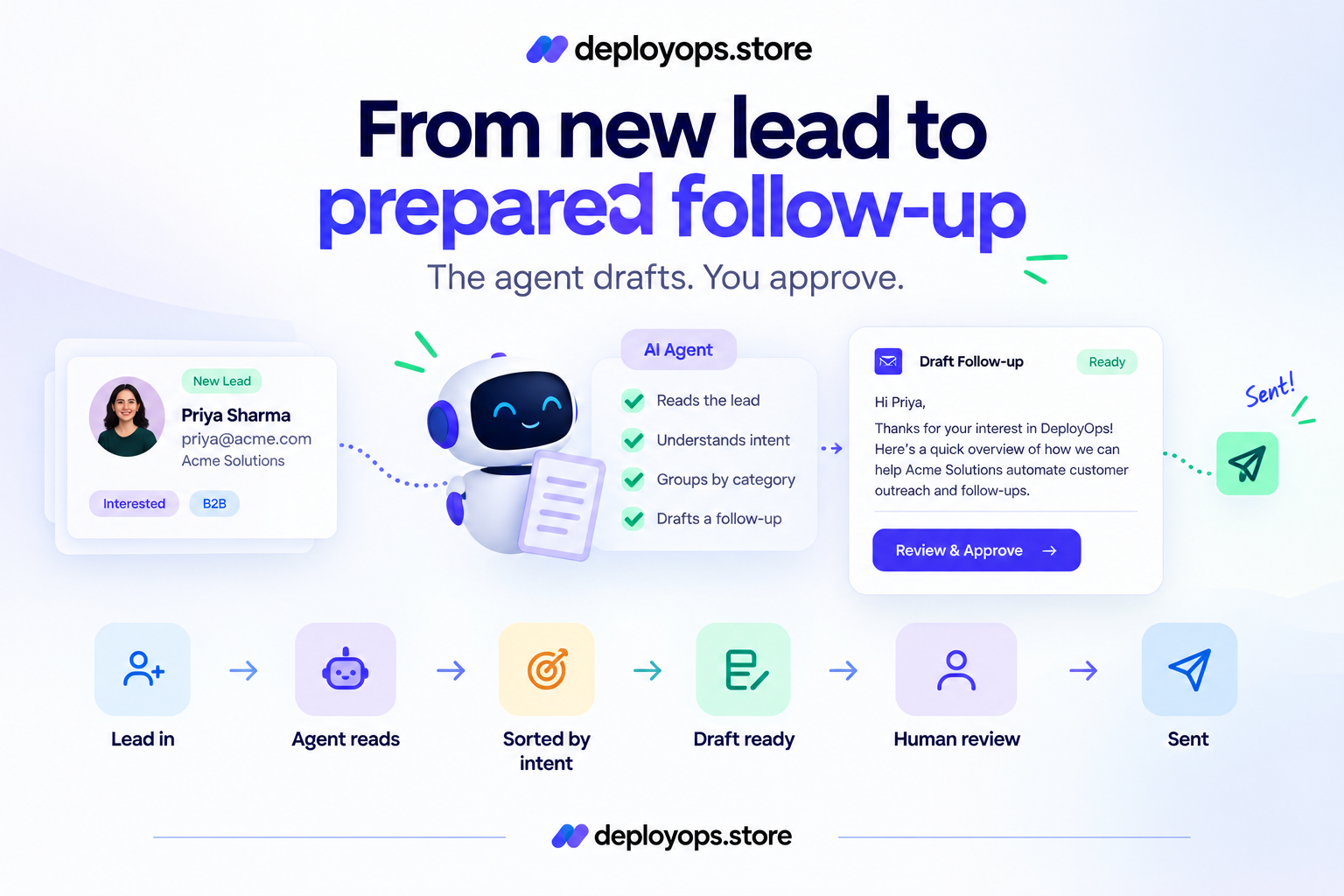
AI lead follow up is a workflow where an AI agent reads a new enquiry, checks what your business already knows, sorts the lead by intent and fit, and drafts a reply in your tone. A person then reviews and approves the message before anything is sent. The agent handles the repetitive preparation. You keep the decisions.
Key takeaways
- Speed matters, but a rushed reply written from memory often does more harm than a prepared one that goes out a little later.
- A reliable lead follow up workflow has five steps: capture, read, sort, draft, review.
- Human review is not a slowdown. It is the step that makes the rest of the workflow safe to trust.
- You can measure the whole thing with four simple numbers: time to first reply, approval rate, edit rate, and reply rate.
Why lead follow up breaks in small teams
It is 4:47 PM and a new lead arrives. Someone filled in your contact form, asked about pricing, and left a phone number. What happens next?
In most small teams, one of three things:
- The enquiry sits in an inbox until tomorrow, when it competes with everything else.
- Someone writes a quick reply from memory, forgets the detail the lead mentioned, and sends something generic.
- The follow up never happens at all, because everyone assumed someone else had it.
None of this is laziness. It is a context problem. The lead’s details are in a form, the history is in someone’s head, the offer is in a document nobody opens, and the person who could reply is in the middle of another task. Follow up fails at the moment of preparation, not at the moment of sending.
That is exactly the part AI is good at. Reading, sorting, and drafting are repetitive tasks that need consistency more than judgment. Judgment still belongs to you.
What AI lead follow up actually means
The phrase gets used loosely, so here is a clear definition. AI lead follow up is not a bot that blasts messages on your behalf. It is a prepared workflow with two kinds of work:
- What the agent does: reads the enquiry, pulls in what your business already knows about the lead, scores intent and fit, and drafts a reply that matches your tone and your current offer.
- What you do: decide what gets sent, to whom, and when. You can edit, reject, or approve every draft.
This split is often called human in the loop. The agent prepares, the person decides. For a small business, that is the difference between automation you can trust and automation you have to watch nervously.
The lead follow up workflow, step by step
Here is how a new lead becomes a prepared follow up. This is the same flow shown in the DeployOps short demo.
Step 1: Capture the lead
A lead fills out your form, sends an email, or messages you through a channel you use. The workflow starts the moment the enquiry lands, so nothing waits for someone to notice it. The raw details are stored in one place: name, company, what they asked, and where they came from.
Step 2: Read the details and check what you already know
The agent reads the message and looks for context. Is this a returning contact? Did they mention a budget, a deadline, or a specific service? Is there an earlier conversation worth referencing? This is the step a rushed human skips, and it is the step that makes a reply feel personal instead of templated.
Step 3: Sort the lead by intent and fit
Not every lead deserves the same urgency. The agent groups leads by intent (ready to buy, still comparing, just browsing) and by fit (right size, right need, right budget range). The result is a short priority list, so you know who needs attention first instead of treating the inbox as one flat pile.
Step 4: Draft the follow up
With the context and the priority in hand, the agent writes a draft in your tone, using your real offer and your real next step, such as booking a call or sending a quote. A good draft answers the question the lead asked, references one relevant detail, and ends with a single clear action.
Step 5: Human review and approval
This is the step that matters most. You see the draft, the lead details, and the reason it was prioritised. You edit if needed, then approve. Nothing reaches a customer until a person says yes. Every handoff is visible, and every decision has an owner.
Where a human should always stay in the loop
If you are building or buying an AI lead follow up system, decide your review points before you switch anything on. These are the checkpoints most small businesses should keep:
- Pricing and commitments. Any message that quotes a price, a discount, or a delivery date should be read by a person.
- First contact with high value leads. The first reply sets the tone of the relationship.
- Sensitive situations. Complaints, refunds, and legal or health related questions need a human voice.
- Anything the agent is unsure about. A good system flags low confidence drafts instead of guessing.
As trust builds, you can loosen review for low risk replies, such as confirming that a form was received. You should never lose the ability to see what is being sent.
A lead follow up email template you can adapt
Here is a simple structure that works for most small business enquiries. Replace the brackets with details from the lead.
Subject: Re: [what they asked about]
Hi [first name],
Thanks for getting in touch about [specific thing they mentioned]. [One sentence that answers their main question or confirms you can help.]
The next step is simple: [one clear action, such as a 15 minute call or a short questionnaire]. Here is a link to choose a time that suits you: [link].
If anything above is not quite right, just reply and tell me.
Best, [Your name]
Notice what is missing: no long pitch, no list of services, no pressure. The goal of the first follow up is to move one step forward, not to close the deal.
Interactive: score your current follow up process
Answer yes or no to each question. Give yourself one point for every yes.
- Does every new lead get a reply on the same working day?
- Does the reply mention something specific the lead wrote?
- Do you know which leads are the most likely to buy before you reply?
- Is there one place where all lead details are stored?
- Does a second person or a clear checklist review replies that include pricing?
- Do you track how long it takes to send the first reply?
Your score:
- 5 to 6: Your process is solid. Automation will mostly save you time.
- 3 to 4: You have a base, but gaps appear on busy days. A prepared workflow will help most with consistency.
- 0 to 2: Leads are likely slipping through. Start with Steps 1 and 2 of the workflow above, then add drafting.
Interactive: run a ten minute audit this week
You do not need software to learn where you are losing leads. Try this:
- Open your last 10 enquiries.
- Write down how long each one waited for a first reply.
- Mark every reply that did not mention a detail from the lead’s message.
- Count how many leads never got a second follow up.
- Circle the slowest step. That is the first thing to fix.
Most teams find that the delay is not in writing the reply. It is in finding the context and deciding who should send it.
Common mistakes to avoid
Automating the send before automating the preparation. Sending faster does not help if the message is generic. Fix the quality of the draft first.
Treating every lead the same. Without sorting by intent and fit, urgent leads wait behind casual ones.
Hiding the workflow. If your team cannot see why a lead was prioritised or how a draft was written, they will not trust it, and they will stop using it.
Skipping the review step to save time. One wrong message to a good lead costs more than the minute you saved.
Measuring nothing. If you do not track results, you cannot tell whether the workflow is working.
How to measure whether it works
Four numbers are enough to start:
- Time to first reply: from enquiry to approved message.
- Approval rate: how many drafts you send as they are.
- Edit rate: how often you change a draft, and what you change. This tells you what to improve in the tone and the offer.
- Reply rate: how many leads respond to the follow up.
A healthy pattern is time to first reply going down, approval rate going up, and reply rate holding steady or improving. If the reply rate drops while speed improves, your drafts are probably too generic.
Frequently asked questions
How do I follow up with a new lead?
Reply as quickly as you can with something specific. Reference a detail from their message, answer their main question, and offer one clear next step. Keep the first message short.
How fast should I respond to a new lead?
As a practical goal, aim for the same working day, and sooner for high intent leads. A prepared draft that is approved quickly is better than a rushed reply that has to be corrected later.
Can AI send follow up emails automatically?
It can, but for most small businesses it should not, at least not at the start. A safer approach is to let the agent draft and prioritise, and have a person approve each message until you are confident in the quality.
Is AI lead follow up safe for a small business?
It is safe when you keep control of what gets sent. Choose a workflow with visible handoffs, clear review points, and the ability to edit or reject any draft.
How is this different from a CRM email sequence?
A standard sequence sends the same pre-written messages on a timer. An AI lead follow up workflow reads each enquiry, adapts the draft to the lead, and puts a person in charge of approval.
See the workflow in action
Reading about the process is useful. Watching it run is better. The DeployOps short demo walks through the full flow, from a new lead to a follow up that is ready to send, with the human review points shown clearly.
Explore the workflow: deployops.store
Conclusion
Good lead follow up is not about being the fastest sender. It is about being prepared every time, even on a busy afternoon at 4:47 PM. An AI agent can read, sort, and draft so the context is never missing. You review, adjust, and approve so the voice and the decisions stay yours.
Start small. Run the ten minute audit, find your slowest step, and fix that first.
One question to leave you with: which step in your lead follow up takes the longest today: reading the enquiry, finding the context, writing the reply, or getting approval? Share your answer and compare it with the workflow above.