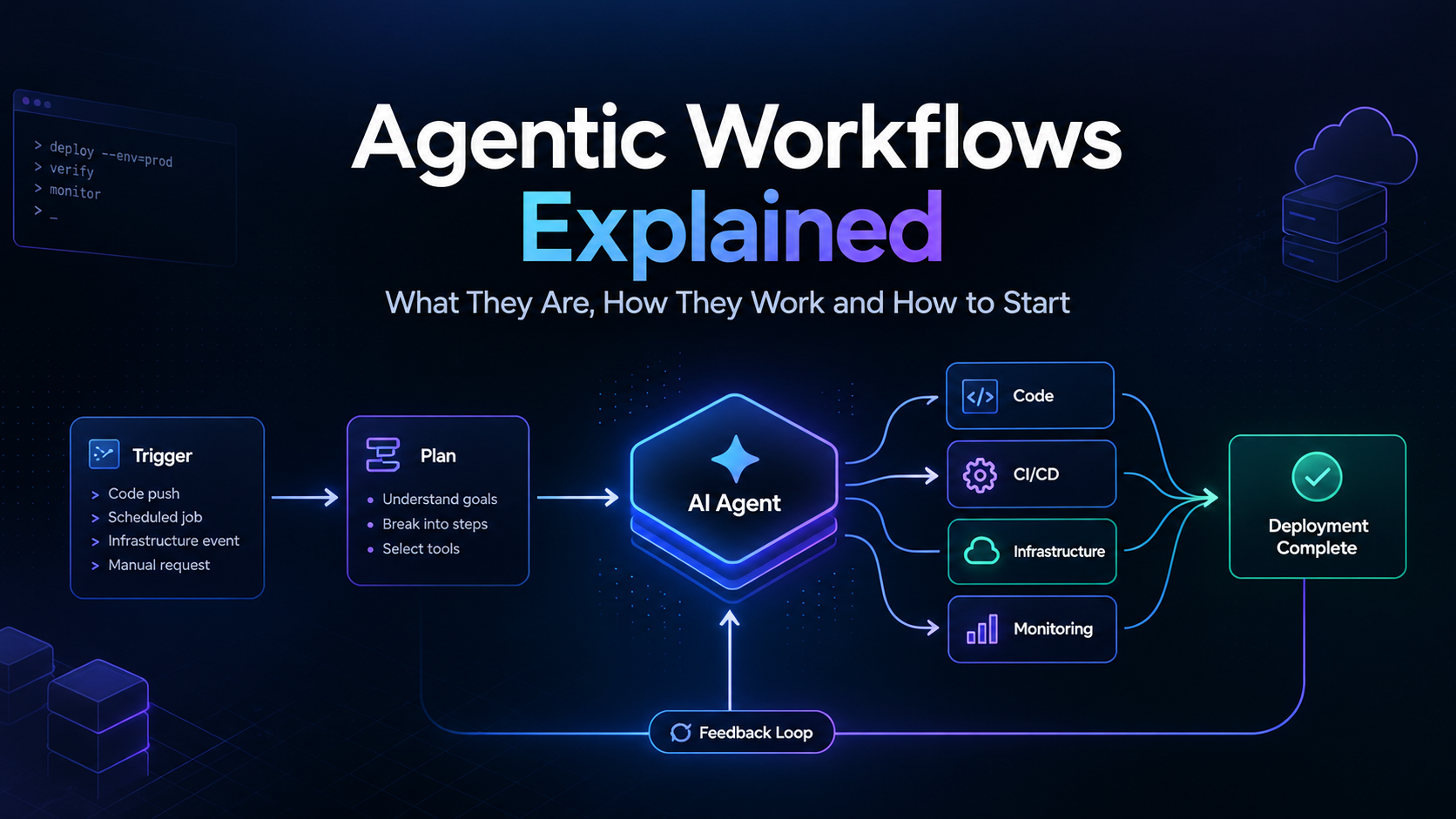
Agentic workflows use AI models to help select or adapt steps within a controlled process. They are useful when inputs vary, but they still need permissions, validation and an accountable owner.
What are agentic workflows in AI?
A workflow may receive a customer request, retrieve relevant information and choose an approved action. Some steps follow fixed rules; others use a model to interpret language or propose the next move.
Agentic workflows vs traditional automation
Fixed automation works well when inputs and decision rules are predictable. An agentic component can help interpret varied messages, but it introduces uncertainty that must be managed.
What happens when something unexpected occurs?
- Unusual request: fixed automation follows its fallback; an agent proposes a category with evidence.
- Missing document: both approaches should flag the missing input; an agent may draft the follow-up.
- Changed business rule: both need an updated approved policy and testing.
An agent should not invent a new policy because an exception appears.
How agentic workflows work
- 1. Perceive: Receive the event and gather authorized context. Check its identity, completeness and age.
- 2. Decide: Use rules and model output to select an allowed next step. Validate both the fields and the business decision.
- 3. Act: Call the permitted tool, record the result and verify that the intended change occurred.
- 4. Review and adapt: Use observed failures to improve the workflow through controlled updates. Saving context does not automatically retrain a model or improve future performance.
Five agentic workflow components
Language models
Interpret text or propose actions within supplied instructions.
Agents and tools
Connect the model’s proposal to limited, authorized operations.
Orchestration
Control sequence, approvals, retries and termination.
Memory and context
Preserve relevant task state under defined access and retention rules.
Human oversight
Review consequential decisions and maintain operating policy.
Frequently Asked Questions
What is an agentic workflow in simple terms?
An agentic workflow is a process in which an AI model helps interpret information or choose an action while software controls the permitted steps. It can combine fixed rules with flexible language understanding. People define the task, access boundaries and review requirements before the workflow operates on business systems.
When is traditional automation the better choice?
Traditional automation is often appropriate when inputs are structured and the required rules are clear. A predictable calculation, field transfer or scheduled notification may not need a model. Add an agentic component only where interpreting varied information provides enough value to justify additional testing, cost and uncertainty.
Does an agent learn automatically from every task?
Not necessarily. Storing task history gives a system context, but it does not automatically update model weights or improve performance. Learning behavior depends on the implemented design. Treat prompt, memory and model changes as controlled updates, and test them before assuming that experience has made the workflow better.
How should an organization start with agentic workflows?
Select one process with variable inputs, a clear owner and an outcome that can be measured. Define permitted actions and escalation rules, then test representative cases before a supervised pilot. Compare completed-task quality, review effort and cost with the existing process before expanding the workflow to additional systems.